Replace Manual Project Management: Building Agent-Assisted Workflows in Domo | Domo BUILD 2026

Thanks for being here. Quick bit about me. As Matt said, I'm Cassidy. I've been in the AI and ML space for over a decade now. But of late I'm a little obsessed with one thing, and that one thing is making AI genuinely dependable to build with. So over the next 7 minutes, I'll walk you through the method that I have kind of authored and run on every single project and show you where cursor in this case, makes it real. So let's get into it.
So let's start with something I think we've all felt. We're all vibe coding now, right? According to a recent GitHub survey, 84% of devs are using AI now. Nearly half the code is AI generated and it feels amazing right up until it doesn't. What I mean is, a working demo isn't necessarily a working product. Essentially the vibe coder prompts straight to code and ultimately is shipping on sand and it slides off its foundation the first time a real load hits.
The agentic engineer on the other hand, builds the foundation first with context, with specs, rules, testing. You really can't prompt your way out of a missing foundation. And that's the line spec driven development draws.
OK, so if that's the problem, here's how I actually build that foundation. This is a method that I authored going on a year ago now and have kind of honed since then. It's essentially 5 core stages, and I follow these stages or these steps truly on just about everything I build nowadays.
More to come on that first step is context, so I'll pull in the raw material, kind of like Ben said, you know, that could include context around gong calls or I often will use deep research with perplexity and so on. From there I'll get into the requirement stage where I'm ultimately distilling that into the real problem and the various constraints.
Once I have the requirements drawn up, I'll shape it where essentially I separate the problem from the solution and choose an approach before any code is written, even if it's done by the agent. Then I'll generate an engineering or Sprint blade based plan and I'll turn that shape into a governed build with rules, GitHub commits, automated and full on human UAT. And then we'll execute across, you know, various parallelized cursor agents which build it literally phase by phase or slice by slice.
And honestly, the thing that makes all 5 work is sitting right underneath. It's the skills, the context in the engine. So that engine is where the real leverage hides.
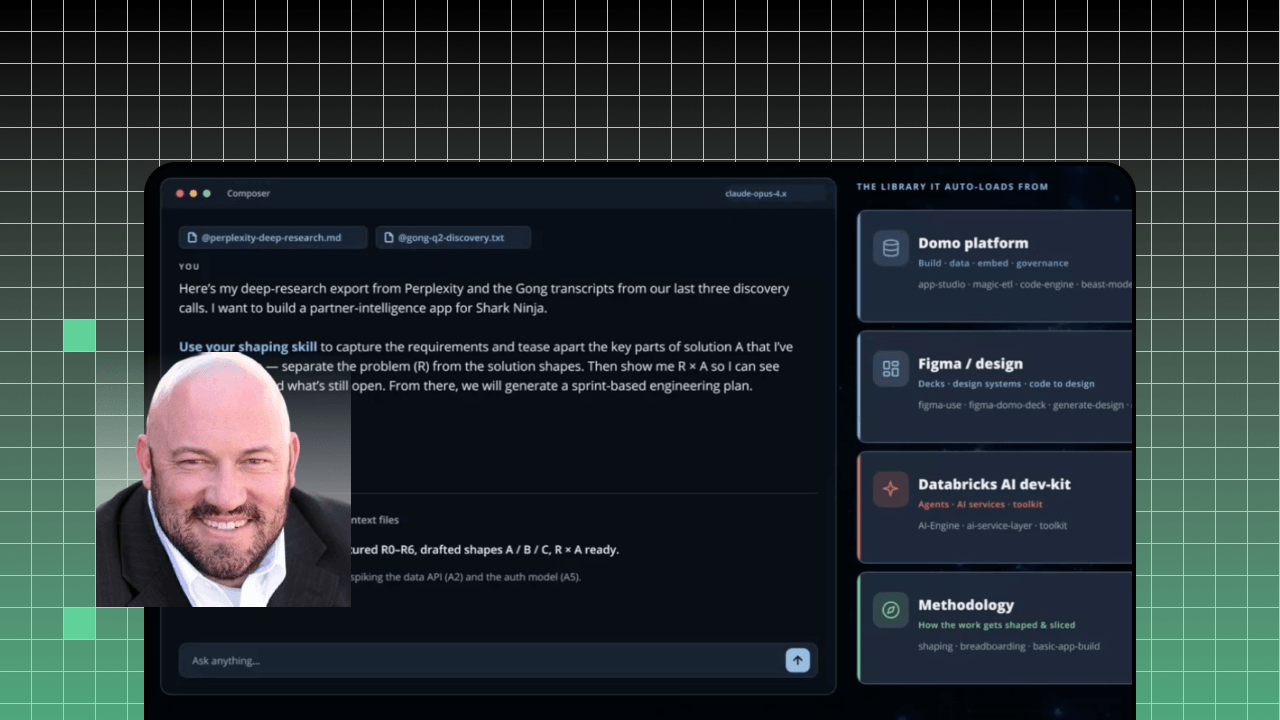
So let me just show you quickly here out to left. I was going to demonstrate this for you live, but in the interest of time, just go with me on this. So I'll drop in a perplexity deep research report and you can kind of see that there's top right. That could be a PDF A markdown file, etcetera, and any additional context that I might have. Again, Ben gave some mentions of this. It could be gong transcripts or anything else that I can leverage with regard to the context around the problem.
And I'll essentially prompt in cursor and say, you know, go out, use your shaping skill and come back with, you know, the various approaches that we could take here. And you can see out to right is that the various libraries in air quotes that I have at my dismay and, and many of you probably have as well to include, you know, Domo skills that my team and I and that the really that the broader engineering team here at Domo have authored. Also, things like the data brick skill sets, the AI dev kit that they just dropped Figma specific skills that we've honed over time with regard to Domo assets and so on. But the general methodology never re derives how we work.
One thing that I wanted to touch on just very quickly, which I'm finding is is kind of a new concept to many is the idea of shaping. So I'll often invoke this shaping skill in, you know, the initial stages of my my development process. So let's slow down on actually what is happening here because it's a step that most people skip, but it is invaluable. It's a reusable methodology that really teaches the agent the exact process that we want to follow here. We'll capture requirements, draft and compare solution shapes and run fit checks, spike the unknowns, and then ultimately slice out the work.
On this slide you can see requirement 01 and two. They're all separated out, right? And they're separated out by shapes, ABC and so on. The fit check will score each shape against every requirement, and a flagged unknown fails until a spike resolves it. So in the initial phases the agent will say, hey, here are various spikes that I don't have answers to yet. Can we work through these together so that I can ultimately come up with a comprehensive plan that is fully bulletproof? So then I'll cut small reasonable slices and every decision is traceable in the master dock, which we will generate.
Now that it's shaped, the question maybe, maybe many people will ask is how do you let agents actually build it without the whole thing just going off the rails, right. This feels really, really big. Well, the answer is rules. Strategically placed rules architected rules that are essentially a living master dock that entails small commits, automated checks against the spec, and a human UAT gate. And this human UAT gate is invaluable as it pertains to making sure that AI remain the expert on the solution that I'm building, and everything is working as expected as we continue to develop it over its life cycle. The agents run the plan, the rules keep them honest.
Now here's the part that genuinely surprised even me as I've continued to leverage this, process it and hone it over the last year or so. None of this is just for code anymore. As I've honed this methodology over the, you know, the last year or so, I found that the exact same pattern can actually be used to build apps, research docs, decks, marketing assets, etcetera. Including, you know, this very deck that I'm showing you all here today, which was shaped plan and built the very same way leveraging Cursor, Figma and some of the Domo specific skills that my team and I have authored.
So in closing, I don't want you to take my word for it. Let me actually show you 4 real builds. These are more recent to me. One spine every time context and specs in products shipped out.
OK, 1st the TDR app or deal inspect. This is an app that prioritizes which deals truly need a technical review and then runs the whole review with live account, Intel and AI chat, all powered by Snowflake and Cortex. That one came together in a 52 week Sprint.
Secondly, a digit digit Asia intelligence hub. This one came together in about 27 minutes if I remember right. It pulls fragmented fintech data into one executive picture of partners risk and market share and an AI agent that surfaces the next cross sell, then the revenue command center. This is a data bricks specific solution. This one took us so about 5 days. Our deepest data bricks build yet. Leaders watch renewal risk live from the lake house. Ask Jeanie why it moved and approve AI recommended saves that right straight back into Unity catalog.
And then finally the 4th proof. As I had mentioned you're looking at it. This deck was shaped, planned and built the exact same way.
So if you take just one thing away from all this, let let it be this context in govern outcomes out the same method every project and it genuinely pays off. Faster upstream work, far fewer hot fixes and rollbacks. Trust me on this.
My ask is simple. Next time open cursor or your IDE of choice, invoke a shaping skill and build on a foundation instead of prompting straight into the sand. Thank you.

Cassidy Hilton is a Solutions Engineering Executive at Domo, specializing in AI, machine learning, and data science. With a background that includes leadership roles at DataRobot and Vianai Systems, he has dedicated his career to building and scaling high-impact technology solutions.An MLOps enthusiast, Cassidy is passionate about creating seamless, end-to-end data products that merge strategic planning with best-in-class software. He holds a Master of Science in Information Management from Arizona State University and brings the same persistence and commitment to excellence to his work that he once applied as a professional powerlifter.
84% of developers are using AI, but nearly half are shipping on sand — prompting straight to code without a foundation. Domo VP of Technology Partnerships Cassidy Hilton introduces the spec-driven agentic development methodology she authors on every project: five stages from context to governed build, with Cursor agents running the plan and strategically placed rules keeping them honest. Watch four real app builds that prove context in, governed outcomes out — every single time.
Domo transforms the way these companies manage business.