Building Custom MCP Agents for Claude Desktop Workflows | Domo BUILD 2026

Hello builders. I'm Ed Engalan, Senior Director for Deployment, and what I'm going to walk you through today is a fun teaching scenario: a fake company with real mechanics. By the end, you'll watch Domo's AI run an actual business, find its biggest problems, both from within the platform and outside of it.
Let's go meet our company, Cedar and Sage. It's a four hundred and eighty million dollar premium food brand. They make pasta sauce, olive oil, fresh pesto, and they sell it in four ways: groceries, clubs like Costco, their own website, and Amazon. The thing they've always struggled with, though, is contribution margin. It's the one number that runs their entire business. For every jar they sell, money comes in, some goes out to make it, to ship it, to sell it, and what's left is contribution margin.
It can be a sneaky one for them, though. If they run a campaign or a promo, they think forty-four percent profitability is good. But when you start to look at the different business units, they actually end up losing money—in this case, three percent per jar. So that is the crux of where we're at today. They've been at thirty-two percent for roughly about three years. Thirty-eight percent has always been the North Star that they've been chasing, and they've never been able to achieve it until now.
So let's start with an OKR for Cedar. How are we going to earn our way to thirty-eight percent? Key result one: lift the margin. Key result two: keep growing net revenue—plus fifteen percent would be great for them without cutting heads. Key result number three: get the forecast right. For a company of their size, four hundred and eighty million dollars in sales, that's about twenty-nine million dollars more a year they'll find without selling actually one extra jar. So it's a pretty relevant case for them, and that's why they're focused so much on contribution margin.
What are you going to see today? For every single teammate, you're going to see some format of AI—an AI agent, a thought partner. That's the biggest thing. You're going to see some orchestration of how things get connected, and number three is you're going to see it inside of Domo. I'm going to show you a little bit of configuration, but you're going to see it headlessly. We're building the platform to go work where everybody else is, right? If you're in Cloud Code, great. If you're in Cortex, great. I'm going to show you today how we can do it in Claude, in Claude Desktop.
If we think about what's inside Domo, what are you going to see today? You're going to see AI toolkits, packages of tools, business context, and you're actually going to see—I'll take you through a scenario of AI agents as well. We have an agent builder platform inside an AI library, pretty cool there. And then there's Domo MCP that truly lets us go out and embark into the world, and all the big spend you've been making in whatever AI products you have, you can integrate with it and it will just be there, the data itself ready, governed, and ready to do some action for you.
If you think about the integration with Claude Desktop, think of it in terms of this analogy: Domo is the body, Claude Desktop will be the head. In the body, you get your governed data, you'll get the AI and the agents, the toolkits, the system of actions, and your write-back—everything we know and love about Domo. But now with the AI and how we're approaching it, you go headless. You can connect through the MCP. You can work within Claude Desktop, whether you're using Co-work or all—you know, you may have some scheduled tasks in there. You actually might have your own designs and all those formats, it all integrates. And that's going to be the big thing that we show you today.
All right, so let's take a quick look at our setup here. We're inside Domo's AI library. If I go to the Rubik's Cube, we find the Domo AI library here. What you'll see is I've made a couple of good toolkits for this example. If you dive into one of these, you'll see each tool has a definition. I can see a description of what I'm looking for that tool to be about. Obviously, I can attach knowledge to that. That could be an existing dataset, a file, or a document, and all of that gets contained inside of a tool that can be accessed via MCP.
The next component here is, if you want to be in Domo, think about it this way: you can plant agents inside of your business, right? All within the platform created here. We're not going to spend much time here, but I'll give you a quick peek. You can query just like you would anything else, and you're having conversations with your data. This is your truest format of a thought partner, all baked within the platform. But that's not the real story we want to tell today.
So what we're going to do is head over to Claude Desktop, and I'll show you how we've connected, and then we'll get into the business of figuring out how we can get to the golden metric of thirty-eight percent. I'll take a quick stop here. We're in Claude, Claude Desktop. See here, I have three of the MCPs connected that you saw in the library. If I minimize that, let's get to work on the thirty-eight percent.
I have a prompt here I wanted to use, one of the toolkits we have, and let's start to diagnose. Let's see what Claude thinks of the problem we're trying to solve. It's calling Domo right now, it's querying the live margin bridge, and it's trying to see, with all the data systems we've connected up, what's going on with our business and how we can diagnose and find the root cause of the problem—something we can actually take action on as a company.
All right, so here are the results, and it's awesome to see, right? Plain as day, DTC has the worst margin. As we continue to look through this over a three-year span, or looking over a span of twelve weeks, it just continues to break down in detail—deep-level analysis. That's why we love AI and LLMs. It can go to the nth degree in terms of the prognosis, and it starts to give a little bit of what we should do next. I should take some of that advice. I'm going to dive into a little bit more regarding that club trade promotion, because I saw that being one of the worst levers or the number one lever we need to pull here, with it being one of the worst offenders for cost margin.
Let's dive into that a little bit and see: is this controlled leakage? Is there something we can fundamentally do about it? We'll dive a little bit deeper into that detail and see where we can go with this analysis next. The cool thing to see here is I'm actually asking the trade partner, because we have a separate toolkit for that, right? So the agent knows it's a different toolkit, different department. It's going to be interesting to see how it interprets that level of analysis as we continue to peel the onion of where the leakage is coming from and what action we could take.
Well, the evidence is pretty damning. If we look at just this segment, our net promo P&L kind of tells the story. We've got eighty-eight things we've got to fix up here, totaling about—it gets us right into the negative, and that hits our bottom line. That's pretty interesting to look at. The next component, I would say, after drilling is: all right, well, what do you do from here? You think of, what else are the intangibles here? If we cut this promo off, are we going to be hurting something else incrementally? Diving into that deep analysis is the next thing we would probably naturally do, right? So let's take a look at that.
You're doing this analysis; these are the moments that matter before you act on anything. You've got to ask different departments whether the fixes create something good for sustainment, or if we are about to have to fix another problem. So it's just a good moment here to pause, to analyze, to reflect, to see: are we doing the right thing at the right time for the right reason?
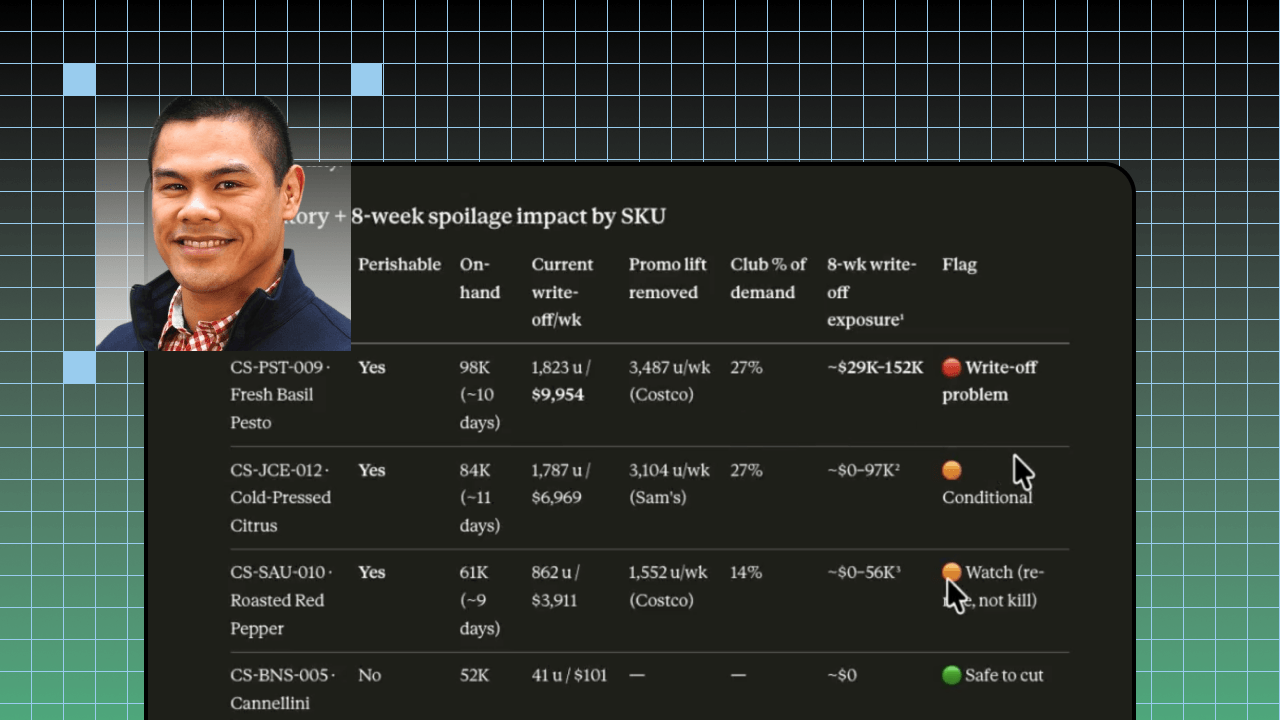
Okay, let's take a look at the results. There is a catch. If you kill the pesto promo, you strand inventory that spoils, about one hundred and seventy-four thousand dollars of write-off risk. Two departments, two systems, one decision. That's pretty cool. This is a cross-functional reasoning that I don't think a company could do before. Let's get to a consensus level here. We want to weigh the pros and cons and see if we can get a recommended action.
We're going to pull all three together, get into a single call, cut the clean ones, and handle the pesto carefully because of demand. Let's see what we come back with and get some action to try to get us closer to that thirty-eight percent. Great.
All right, so final recommendation: cut two, rework two, and hold four of them. It looks like pesto and citrus shews we'll cut. We need to rework the roasted red pepper and the heirlooms, and then hold on the olive oil. That's pretty cool. What we're seeing here, again, is this is thought partnership, where you have the reason we're going to do some deep analysis.
And then, fundamentally, from this—I don't have it live-wired to the memory, but in that event, I would say, when we do, I would do something like this. In a continuous learning system, I would have a write-back into AppDB memory. That way, the IT will permeate through the agents as other departments are working to and through this recommendation, this kind of experiment. I was doing research; you can have it push right back into memory. Obviously, cloud memory is good, but to push it back to Domo, you can store that memory in AppDB.
Then every subsequent query or any agent that's doing any interaction, you can set it up so that it's looking at the datasets, but it can also be looking at AppDB memory and then formulating similar recommended actions right at a department level, whether you're in finance or if you're in the DTC group. They're all going to start to unify on this kind of evolving Intel. That's what you get to see here. I'm doing it in Claude Code, and all I have to do is a simple write-back, and the folks who are native in the platform working with agents or having agents on a schedule do some analysis, we're in one fundamental ecosystem, being Domo, kind of at the heart of our business. That's what we consider when we think about Domo as an operating system that sits at the center and the core of your business.
That brings us to a close. We didn't make a model today, right? We made a model smarter. We connected it to the business. The data was always there. We had roughly eight systems in this example that you saw over three years trying to get to one OKR, and no one could see it. You give every department an agent. You get them connected to the right data, you get orchestration in place, and just from simple things that we do and start to leverage with AI being thought partners and helping it reason with us, you can see your business holistically all the way through Domo. All right, builders, thank you for the time and happy building.

Ed Engalan is a Senior Director of Consulting at Domo who specializes in helping organizations build unified data platforms that automate decision-making, drive prescriptive insights, and enhance data literacy across teams. With over six years at Domo and extensive leadership experience, Edgardo partners with clients to transform complex data into actionable strategies that fuel business growth. Before Domo, he held key roles in business intelligence and agile transformation, blending technical expertise with a strong focus on building data-driven cultures. He holds a Computer Science degree from Western Michigan University and is passionate about empowering organizations to leverage data as a strategic asset.
AI is only as powerful as the systems it can securely connect to. Domo Senior Director of Consulting Ed Engalan shows how to build custom MCP servers from scratch, deploy them as embedded AI agents, and connect them to Claude Desktop to trigger external tools and run complex cross-platform workflows. Walk away with a working blueprint for multiplying your operational impact without rebuilding your existing tech stack.
Domo transforms the way these companies manage business.