9 Best Text-to-SQL Tools for Business Intelligence in 2026

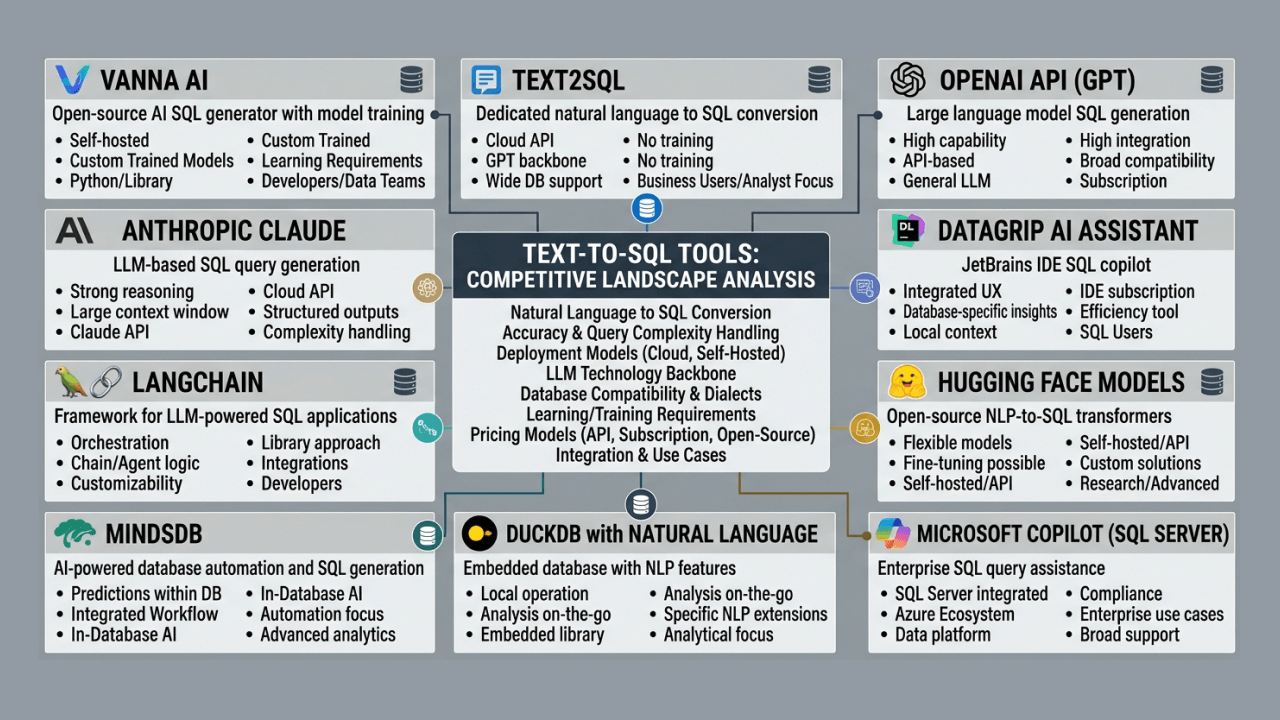
The market for text-to-SQL tools has fractured. Three categories now compete for attention: standalone generators that connect to any database, embedded features inside existing BI platforms, and agentic assistants that interpret results and trigger actions. This guide breaks down nine tools across those categories, explains what separates enterprise-ready options from lightweight alternatives, and walks through the evaluation criteria that actually predict production success.
Why text-to-SQL tools matter now
A text-to-SQL tool takes a question you type in plain English and turns it into database code that runs automatically. You ask "What were total sales in Europe, the Middle East, and Africa (EMEA) last quarter?" and the tool writes the query, runs it, and hands you the answer. Simple as that.
Data teams field dozens of ad-hoc requests every week. Each one takes hours. Text-to-SQL shifts those low-complexity questions to the people who actually have them. Faster answers for business stakeholders. Deeper work for analysts.
The shift away from static dashboards toward conversational analytics has accelerated, and it's been a long time coming. The trend is clear: People want to interact with data dynamically, not wait for someone to build another report. But because these tools touch raw database tables, governance determines enterprise viability just as much as translation accuracy.
What text-to-SQL tools are
Text-to-SQL is exactly what it sounds like. Type a question. The tool generates code, executes it against your database, returns results.
This differs from BI search features that only query pre-modeled semantic layers. Also differs from code-completion plugins that help developers write SQL faster. Text-to-SQL targets business professionals who don't write code at all. Tools designed for developers assume familiarity with database concepts, while tools built for business stakeholders must handle ambiguity gracefully and surface results without requiring technical interpretation.
Types of text-to-SQL tools
Should you buy a standalone product or use the conversational features inside your existing data platform? Depends on where your data and governance rules already live.
Three categories dominate:
- Standalone generators: Connect to any database and translate questions to code. Best when you lack a unified analytics platform or want something database-agnostic. Requires separate governance integration.
- Embedded natural language querying: Features built into existing BI platforms. Security rules inherit automatically from the semantic layer. Best when you already govern data through that platform.
- Agentic data assistants: AI agents that generate queries, interpret results, ask clarifying questions, and trigger downstream actions. Best when the goal is workflow automation, not just query generation. Requires strong human-in-the-loop controls.
Standalone tools offer flexibility. Embedded tools offer governance continuity. Agentic assistants offer automation but demand more oversight.
{{custom-cta-1}}
Quick summary of text-to-SQL tools
9 best text-to-SQL tools
Domo
Domo is an agentic platform for the intelligent enterprise that helps teams prepare governed data for AI, turn that data into action with human-in-the-loop agents, and distribute outcomes into the tools people already use. It's unified by design, modular by adoption, so teams can start with a single product and expand as needs grow.
The platform runs on top of cloud data platforms like Snowflake, Databricks, and BigQuery, carrying governance from ingestion through query execution. Its AI Service layer lets organizations use their preferred inference models while Domo coordinates requests, carries the requester's identity through to governed data, and records activity for audit trails. Human-in-the-loop controls keep agents operating with bounded autonomy. Results reach people through mobile apps, embedded analytics, Slack, or automated workflows.
Key differentiators include agents that operate with bounded autonomy. Humans set objectives and constraints while machines execute within those boundaries. Row-level and column-level security are enforced at query time. The platform runs on top of existing cloud data systems rather than replacing them.
Designed for enterprise environments with complex data needs. Teams seeking a lightweight standalone generator may find more capability than required.
{{custom-cta-2}}
ThoughtSpot
ThoughtSpot pioneered search-driven analytics. Its search bar accepts plain language questions and returns visualizations using a specific modeling language to improve accuracy.
The platform works best when organizations commit fully to its semantic layer. Security and metric definitions inherit directly from the underlying model. AI features surface anomalies and generate explanations automatically.
For teams wanting a database-agnostic tool (or those already governing data elsewhere), the fit becomes less obvious.
Microsoft Power BI
Power BI brings natural language querying to organizations already invested in the Microsoft ecosystem. Type questions in plain language and get visualizations quickly, but the experience depends heavily on how well the model is maintained and how consistently metrics are defined across workspaces.
Accuracy depends heavily on the underlying data model and the synonyms configured within it. Copilot features extend functionality with generative summaries and automated report creation. Security inherits from Azure Active Directory and workspace permissions.
Best value for organizations already running on Microsoft infrastructure.
Salesforce Agentforce
Agentforce embeds AI agents into Salesforce workflows to answer data questions and trigger automated actions. Agents connect to Data Cloud and external sources, answer questions in natural language, and execute follow-up actions like creating tasks or sending notifications.
Strongest for organizations whose primary data context lives inside Salesforce. Connecting to external warehouses requires significant Data Cloud configuration, which can become a project unto itself.
Vanna.AI
Vanna.AI is an open-source framework that lets organizations self-host and customize their entire translation pipeline. It uses retrieval-augmented generation to ground queries in schema metadata and past query examples.
Organizations can run it entirely on their own infrastructure, connect to any database, and fine-tune the underlying model on their specific data. Requires dedicated technical resources for setup and ongoing maintenance. Not a turnkey SaaS product.
Sequel.sh
Connect a database and start querying in minutes. Sequel.sh connects to common databases like Postgres, MySQL, and Snowflake, accepts plain language questions, and returns code alongside visualizations.
Governance features are limited compared to enterprise platforms.
SQL Chat
SQL Chat is an open-source, chat-based interface for querying databases. The project can be self-hosted for maximum privacy. No licensing cost for the core product.
Limited enterprise features. No built-in role-based access control, audit logging, or semantic layer integration. Best for technical teams comfortable managing their own infrastructure.
Chat2DB
Chat2DB combines a standard database client with AI query assistance. Write code manually, ask the system to generate queries, or use the assistant to explain and optimize existing code.
Oriented toward technical professionals. Business stakeholders unfamiliar with database concepts may find the interface overwhelming.
Outerbase
Outerbase provides a visual interface for browsing, querying, and editing data. Its AI feature generates queries from natural language and supports both SQL and NoSQL syntax.
Less depth in governance and semantic layer integration.
How to evaluate text-to-SQL tools
Demo accuracy alone doesn't predict production success. This is where many pilots stumble. Accuracy degrades when schemas change, when questions are ambiguous, or when the tool lacks business context.
Governance and access control
The tool must enforce the same access controls as the underlying database. Look for role-based access control, row-level security, column-level security, single sign-on integration, and audit logging.
Ask whether the tool passes user identity through to the warehouse or uses a generic service account that bypasses row-level policies. A generic service account might return accurate results while exposing data the requesting person should never see. Create two test accounts with different security policies and verify each sees only permitted rows.
Accuracy and query safety
Safety matters more than accuracy. A tool that generates a correct but inefficient query can spike warehouse costs. A tool that generates an update statement can cause damage.
Run representative questions and compare results to known answers. Attempt to prompt the tool to generate a write operation. Verify the system blocks it.
Schema grounding
Translation accuracy improves when the tool knows the schema, metric definitions, and business context rather than just raw table names. Schema grounding isn't optional if the goal is consistent answers as schemas and definitions change. Without it, text-to-SQL tools guess at meaning rather than understanding it. Look for integration with semantic layers, data catalogs, or built-in metadata management.
Ask a question that requires understanding a specific business metric. Verify the tool uses the correct definition from the semantic layer.
Performance
Query latency affects adoption. If people wait 30 seconds for a response, they abandon the tool. Simulate concurrent requests and measure response times. Check whether asking the same question twice returns a cached result.
Commercial model
Pricing models vary across per-seat, per-query, per-compute-minute, or bundled platform structures. Factor in inference costs if the tool uses external models, plus warehouse compute triggered by generated queries.
A seemingly free tool can become expensive if it consistently generates inefficient queries that scan massive tables.
Common buyer mistakes in text-to-SQL adoption
Evaluating on accuracy alone causes problems. Demo environments are clean. Production environments? Schema drift, ambiguous column names, edge cases everywhere. Test with messy schemas and ambiguous questions.
Skipping governance review creates compliance risk. A tool that bypasses row-level security exposes sensitive data. Verify identity passthrough before production rollout.
Ignoring the cost model leads to surprises. A tool that scans full tables on every question spikes warehouse bills. Monitor query costs during the pilot and set compute caps.
Underestimating change management slows adoption. Business professionals need training and trust-building. Start with a small pilot group and iterate on prompt guidance before broad rollout.
The category is moving toward agentic assistants that generate code, interpret results, and trigger actions. With Deloitte reporting only 21 percent of organizations have mature agent governance, this raises the stakes for human-in-the-loop controls. That gap between agentic capability and governance readiness is where most enterprise deployments stall.
Final guidance for selecting text-to-SQL tools
If your organization already governs data through a specific analytics platform, evaluate that platform's conversational features first.
If data sovereignty or self-hosting is required, prioritize open-source or self-hosted options like Vanna.AI or SQL Chat.
If the goal is workflow automation rather than just query generation, evaluate agentic platforms with human-in-the-loop controls.
Run a pilot with messy data and skeptical stakeholders before committing. Monitor governance, accuracy, and compute costs during that pilot.
For organizations that need governed AI agents delivering outcomes into workflows people already use, explore Domo's AI capabilities. Get a demo.
Key takeaways
Text-to-SQL tools succeed when governance, context, and performance are treated as first-class requirements.
- Pilot with ambiguous questions and messy schemas, not demo-friendly data
- Require identity-based access controls, including row-level and column-level security
- Ground questions in shared metric definitions through a semantic layer or catalog
- Test query safety and cost controls, not just whether answers look right
- Choose agentic assistants when the goal is action in workflows, not only query generation