Best ETL Tools for Amazon Redshift in 2026

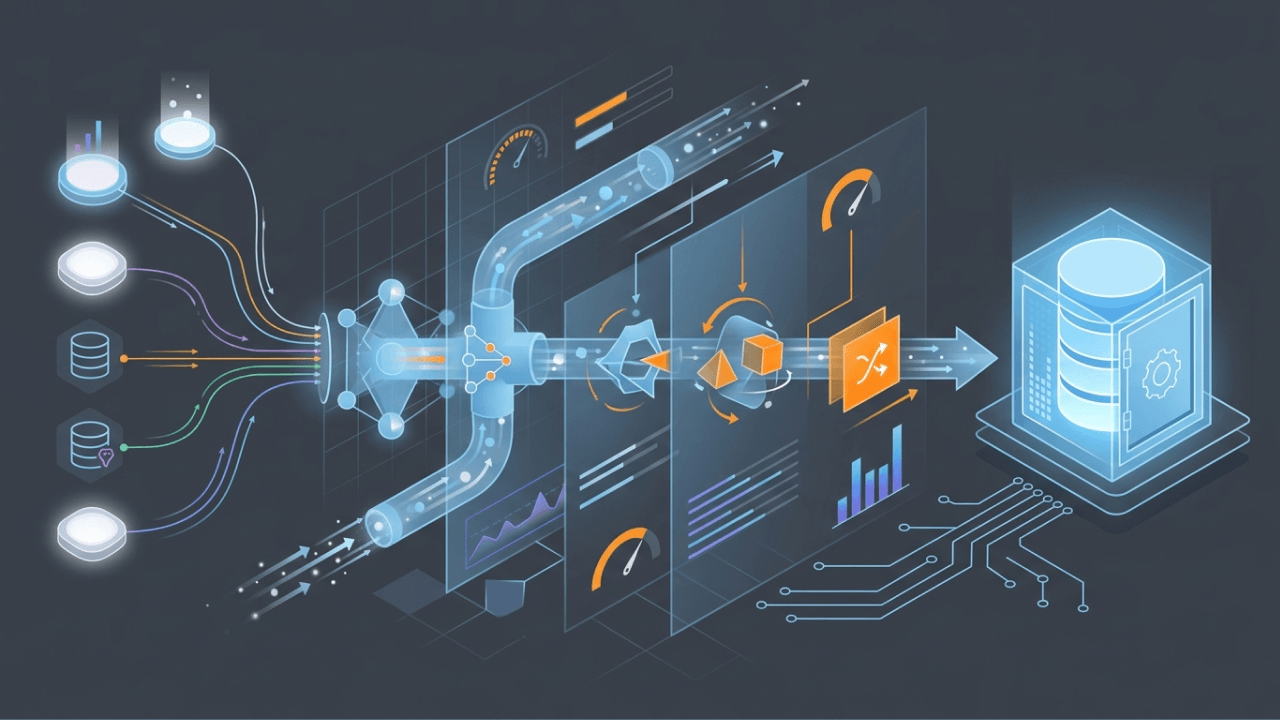
Choosing an ETL tool for Redshift now means looking at three distinct categories: managed ELT platforms that automatically handle connector maintenance, open-source tools that give you full control over your pipeline, and native AWS services that keep everything within the Amazon ecosystem. This guide breaks down nine leading tools from these categories, explains what's really important when you're evaluating them, and covers how your choice affects AI readiness.
Why Redshift ETL tools matter now
Your nightly Redshift load failed because a source schema changed overnight. Dashboards are stale. Stakeholders are asking questions. This is what moving data into a cloud warehouse at scale actually looks like.
ETL tools for Redshift extract data from source systems, transform it into a usable format, and load it into your warehouse. Extract, load, transform (ELT) flips the order. Load raw data first, then transform it inside Redshift using its processing power. Because Redshift's columnar storage and massively parallel processing make it exceptionally good at transformations, it's precisely why ELT has become the dominant pattern.
Amazon has expanded Redshift's native capabilities significantly. Streaming ingestion, zero-ETL integrations with Amazon Aurora, the SUPER data type for semi-structured data. All of these reduce the need for external tools in specific scenarios. But when your sources span SaaS applications, on-premises databases, and event streams? You still need something to orchestrate the movement.
AI workloads have changed the calculus entirely. The same warehouse powering your dashboards now feeds AI agents making operational decisions, and, according to McKinsey, eight in ten companies cite data limitations as a roadblock to scaling them. That statistic reveals the gap between AI ambition and data infrastructure reality. Data freshness and lineage are no longer just BI concerns.
Types of Redshift ETL tools
Before comparing vendors, you need to decide which category fits your architecture. Choosing the wrong category leads to wasted engineering hours or unexpected costs.
Managed ELT platforms
These tools handle connector maintenance, schema drift, and incremental sync logic automatically. You configure the connection. The vendor keeps it running. This approach works well when your sources are standard software-as-a-service (SaaS) applications or databases with change data capture (CDC) support.
Pricing varies significantly. Some charge per row synced, others per connector or monthly active rows. A source that syncs a million rows daily can cost dramatically different amounts depending on the vendor's model. Don't assume the cheapest per-row rate wins. High-volume sources can flip that math quickly.
{{custom-cta-1}}
Open-source and orchestration-first tools
Full control over pipeline logic and versioning. Teams adopt this approach when they have engineers comfortable with Python or SQL, when custom transformation logic is required, or when Git-based version control is a governance requirement.
The operational burden falls entirely on your team: connector updates, infrastructure scaling, monitoring. That ongoing maintenance cost is easy to miss when you compare open-source options to managed alternatives.
Native AWS services
AWS Glue, AWS Database Migration Service (DMS), Kinesis Data Firehose, and Redshift's zero-ETL integrations keep data movement inside the AWS ecosystem. AWS Identity and Access Management (IAM) and Lake Formation handle governance natively.
Zero-ETL currently supports limited sources. Glue's serverless Spark jobs can become cost-opaque for large transformations if you aren't watching closely.
Top Redshift ETL tools
These tools were selected based on analyst coverage, review platform ratings, and market adoption. The list isn't ranked, and order doesn't imply preference.
Fivetran
Fivetran handles connector maintenance so you don't have to. Schema changes in source systems propagate automatically. The platform uses Redshift's COPY command for bulk loads and supports incremental change data capture.
Best for teams that want to eliminate pipeline maintenance entirely. Pricing scales with data volume, which can escalate quickly with high-volume sources. Most teams pair it with data build tool (dbt) for transformations.
Hevo Data
A no-code ELT platform with a visual pipeline builder. Pre-built transformations let you clean data without writing SQL. The native Redshift connector uses COPY-based loading.
Best for mid-market teams that want managed connectors plus light transformations. The connector catalog is smaller than some competitors.
Stitch Data
Straightforward replication without transformation. You configure the source, and Stitch moves the data with minimal setup.
Good fit for teams planning to handle transformations inside Redshift or with dbt. The trade-off is that transformation, governance continuity, and lineage requirements need to be handled elsewhere.
AWS Glue
A serverless ETL service with Spark-based transformations. Glue Studio provides a visual editor for building jobs. Native Redshift connector integrates with Lake Formation for governance.
Best for AWS-committed organizations needing complex transformations. Spark job costs can be unpredictable, and debugging requires Spark expertise.
Airbyte
Open-source ELT with a large connector catalog. Available as self-hosted or managed cloud. The connector development kit lets you build integrations for custom sources.
Best for teams wanting open-source flexibility with an option to move to managed cloud later. Self-hosted deployments require infrastructure management.
Matillion
Visual transformation builder with SQL pushdown into Redshift. Transformations execute inside your warehouse using generated SQL, which reduces data movement.
Good fit for teams that want visual transformation design while still running work in Redshift. The trade-off is that teams may need to validate generated SQL patterns and manage platform-specific development practices.
Integrate.io
Low-code ETL with change data capture (CDC) capabilities. The visual pipeline designer focuses on accessibility.
Good fit for teams that need CDC from databases without deep engineering resources. The trade-off is that advanced governance, lineage, and orchestration needs may require additional tools, depending on the implementation.
Talend
Enterprise data integration with extensive governance, lineage, and data quality features. Native Redshift connector supports both COPY and JDBC loading.
Best for large enterprises with complex governance requirements. Steeper learning curve and enterprise-tier licensing.
Domo
An agentic platform for the intelligent enterprise that includes managed data integration alongside AI agents and automation. Native Redshift connector with scheduled and on-demand syncs. Role-based access defined during ingestion carries through to AI agents and workflows, with human-in-the-loop oversight so people set objectives and constraints and agents execute within those boundaries.
Best for organizations unifying data integration, analytics, and AI activation on a single governed platform. Strongest value appears when teams use Domo's broader capabilities beyond standalone ETL.
{{custom-cta-2}}
How to choose Redshift ETL tools
Teams often pick based on connector count alone. Six months later, poor CDC quality, unpredictable pricing, or governance gaps create operational problems.
Here is what actually matters:
- Connector quality over quantity: Does the tool support log-based CDC for your databases? Timestamp-based CDC misses deletes. How does it handle API rate limits for SaaS sources?
- Loading method: Tools that stage data in Amazon Simple Storage Service (Amazon S3) and use Redshift's COPY command load fast. Tools that insert row-by-row via Java Database Connectivity (JDBC) load slowly. Check your Redshift query logs during initial loads. Thousands of INSERT statements instead of COPY commands signal a problem.
- Pricing model fit: Per-row pricing can spike when AI workloads (now present in 88 percent of organizations) increase sync frequency. This widespread AI adoption means your data volumes will likely grow faster than historical trends suggest. Calculate total cost at current and projected volumes before committing.
- Governance continuity: Access controls defined during ETL should carry through to consumption. Tools that treat ETL as a separate silo create gaps when multiple teams access the warehouse.
- Ecosystem fit: Does the tool integrate with your existing orchestration and transformation stack, or does it require replacing everything?
Getting Redshift data ready for AI
ETL tool choice directly affects AI readiness. Three factors determine whether your warehouse data can power AI agents:
- Freshness: AI agents making operational decisions need current-state data, not yesterday's snapshot. Tools with streaming change data capture (CDC) support this. Batch-only tools don't.
- Lineage: When an AI agent produces unexpected output, you need to trace back to source data. Tools with OpenLineage (a standard for lineage metadata) or native lineage tracking make this possible.
- Governance continuity: Role-based access defined during ETL should carry through to AI consumption. Platforms like Domo maintain this continuity from ingestion through AI agents and workflows.
Domo is unified by design and modular by adoption. Teams can start with data integration as the Foundation, making Redshift data AI-ready with governed access and traceable logic. From there, Activation uses agents and apps to turn that governed data into action, and Distribution delivers outcomes into the tools people already use. As adoption expands, value compounds because data, logic, and governance are defined once and reused everywhere.
If you want to see what governed Redshift ingestion looks like when it's built for analytics and AI from day one, get a demo and map your freshness, lineage, and access needs to a setup you can actually trust.
Key takeaways
If the goal is dependable Redshift pipelines that can also support AI use cases, focus on a few decision points first:
- Connector quality matters more than connector count, especially for log-based CDC and schema drift
- COPY-based loading via Amazon S3 is usually the clearest path to predictable Redshift performance at scale
- Pricing can change quickly when sync frequency increases, model total cost at today's and projected volumes
- Lineage and access controls should carry from ingestion through AI and workflow automation, not stop at the warehouse