RAG vs Fine-Tuning: Choosing the Right Approach for Your AI Implementation

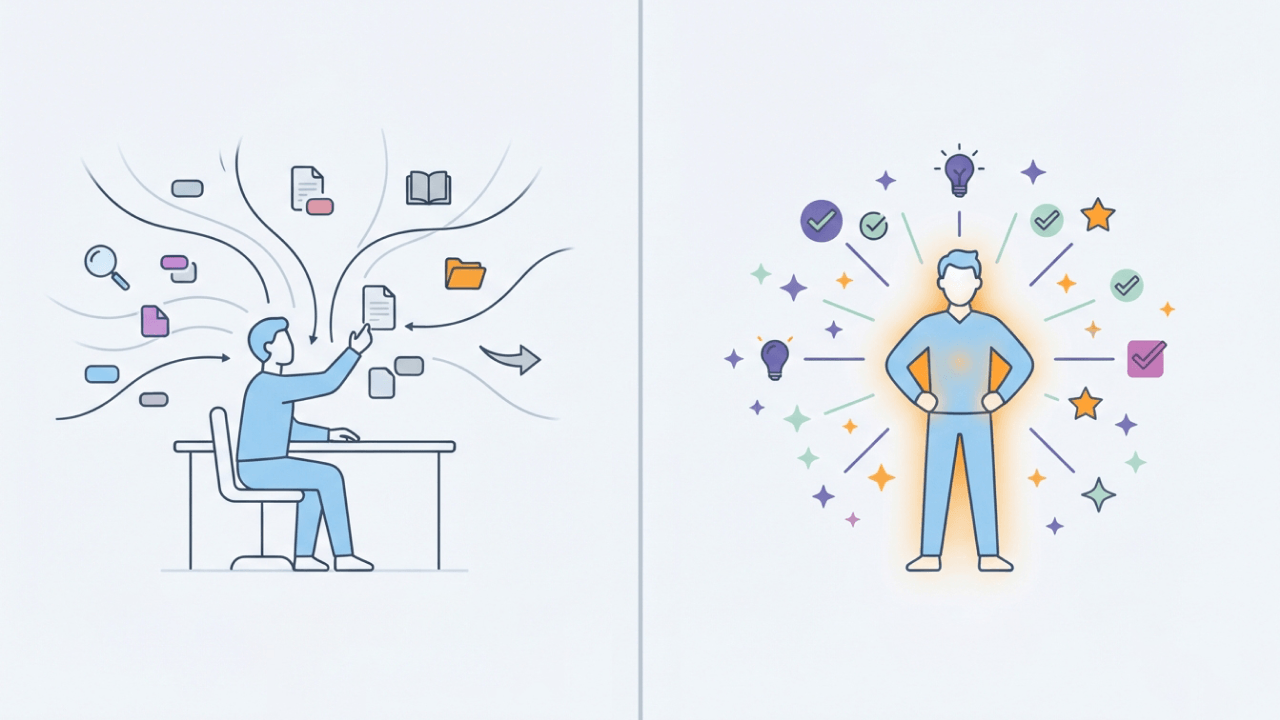
Retrieval-augmented generation (RAG) and fine-tuning solve fundamentally different problems. RAG adds knowledge the model can reference. Fine-tuning changes how the model behaves. This article explains the technical differences between both approaches, compares them across governance, cost, and accuracy, and provides a decision framework for choosing where to start.
Key takeaways for RAG vs fine-tuning
RAG retrieves external information at query time and adds it to the prompt. Fine-tuning permanently changes the model's internal weights through additional training. They solve different problems, and picking the wrong one wastes months of work.
- Knowledge vs behavior: RAG adds what the model knows. Fine-tuning changes how the model responds.
- Data freshness: RAG reflects document updates immediately. Fine-tuning freezes facts at training time.
- Governance: RAG supports per-query access control and audit logs. Fine-tuning bakes knowledge into weights where you cannot restrict it by person or role.
- Cost structure: RAG costs scale with query volume. Fine-tuning costs hit upfront during training and again whenever you retrain.
- Hybrid reality: Most production systems use both. The real question is which to start with.
If your answer changes when the source document changes, start with RAG. If your output format or tone needs to change, consider fine-tuning.
RAG vs fine-tuning at a glance
| Criterion | RAG | Fine-tuning |
|---|---|---|
| Best for | Dynamic knowledge, citations, compliance | Consistent format, tone, tool-calling |
| Data freshness | Real-time | Static snapshot |
| Governance | Permissioned retrieval, audit logs | Knowledge embedded in weights |
| Setup complexity | Moderate | High |
| Cost driver | Per-query retrieval | Upfront training compute |
| Latency | Adds retrieval step | No retrieval overhead |
What is retrieval-augmented generation?
You keep your large language model (LLM) unchanged. That is the key insight here. Instead of modifying the model, you feed it relevant context pulled from external sources right before it generates a response.
When someone asks a question, the system searches a knowledge base for related chunks of text. Those chunks get inserted into the prompt alongside the original question. The model reads everything together and generates an answer grounded in that retrieved context.
The model's weights never change. Only the input changes. Update your source documents tonight, and tomorrow's answers reflect those updates. No retraining required.
RAG differs from embeddings (which are just one component of a RAG system) and it differs from fine-tuning (which actually modifies the model). Think of RAG as giving the model a reference book to consult rather than teaching it new information permanently.
The advantages stack up quickly for certain use cases:
- Current knowledge: Update documents and the next query reflects those changes.
- Citations: Responses can reference exactly which chunks they drew from.
- Access control: You can filter retrieval results by role-based permissions before the model ever sees them.
But RAG has limits. If your retriever pulls back irrelevant chunks, the model hallucinates anyway. Each query adds latency from the retrieval step. And very long documents require chunking strategies that sometimes lose important context. Teams often underestimate how much retrieval quality determines overall system accuracy. A perfectly capable model cannot compensate for chunks that miss the point.
{{custom-cta-1}}
How RAG works
Most RAG pipelines fail at retrieval, not generation. The model can only work with what you give it.
Query intake
The question enters the system. Sometimes you rewrite or expand the query first to improve search results. A vague question like "what's the policy?" might become "what is the company refund policy for enterprise customers?" before hitting the retriever.
Retrieval
The system searches a vector database for chunks semantically similar to the query. You typically retrieve somewhere between five and 20 chunks. Too few and you miss relevant context. Too many and you drown the signal in noise.
Hybrid search combines semantic similarity with keyword matching. This catches both conceptually related content and exact phrase matches. Access control filters apply here too, so people only see documents they are authorized to access.
Augmentation
Retrieved chunks get inserted into the prompt template alongside the original question. A reranker can reorder chunks by relevance before insertion. The prompt usually instructs the model to cite sources and admit when the context does not contain an answer.
Generation
The LLM generates a response based on the augmented prompt. Because the weights never changed, the response reflects retrieved context rather than memorized training data. Citations can reference specific chunk identifiers or document titles.
Caching common queries reduces both latency and cost.
What is fine-tuning?
Fine-tuning takes a pre-trained model and continues training it on your specific examples. This adjusts the model's internal weights so it produces outputs matching your desired patterns.
Here's what fine-tuning actually does well: it changes behavior. You can teach a model to respond in a particular tone, follow a specific output format, or reliably call tools in a certain way. After fine-tuning, the model exhibits these behaviors without needing lengthy instructions in every prompt.
What fine-tuning does not do reliably is add new factual knowledge. Facts learned during fine-tuning get frozen in the weights. They can't be updated without retraining. And they sometimes conflict with the model's original training data in unpredictable ways. Teams often spend months fine-tuning on product specs, then see the model confidently cite outdated pricing a few weeks later.
The practical benefits look like this:
- Consistent output format: Train on JavaScript Object Notation (JSON) schema examples, and the model reproduces that structure reliably.
- Shorter prompts: Behavior encoded in weights means you do not need to repeat instructions every call.
- Domain voice: The model adopts your terminology and tone without constant reminders.
The downsides matter too. Knowledge goes stale. Aggressive fine-tuning can degrade the model's general capabilities. And curating high-quality training examples takes significant effort.
How fine-tuning works
Dataset quality determines outcomes more than any hyperparameter you tune.
Dataset curation
You need prompt-response pairs demonstrating exactly the behavior you want. A few hundred excellent examples typically outperform thousands of mediocre ones.
Include edge cases and failure modes, not just happy paths. Add negative examples showing what the model should refuse to do. Coverage matters more than volume. Training only on ideal outputs without showing the model how to handle ambiguous or malformed inputs? That's where things go sideways. When those edge cases appear in production, the model improvises (often badly).
Supervised training
Run the training job using either full fine-tuning or a parameter-efficient method like low-rank adaptation (LoRA), depending on your compute budget. Watch for overfitting where training loss drops but validation loss rises. Save checkpoints so you can roll back if something goes wrong.
Evaluation
Test against a held-out evaluation set and against the base model to catch regressions. Measure both task-specific metrics and general capability. If edge cases fail, add more examples and retrain.
Full fine-tuning updates all weights. Parameter-efficient methods update only a small subset, reducing compute costs and the risk of degrading general capabilities.
{{custom-cta-2}}
RAG vs fine-tuning head-to-head comparison
| Criterion | RAG | Fine-tuning |
|---|---|---|
| Ease of use | Moderate setup, no ML training needed | High setup, requires ML expertise |
| Data governance | Per-query access control, audit logs | Knowledge baked into weights |
| Accuracy | Depends on retrieval quality | Depends on dataset quality |
| Scalability | Add documents to index | Retrain for new behaviors |
| Cost | Per-query retrieval costs | Upfront training, periodic retraining |
| Traceability | Citations link to sources | No native citation mechanism |
Ease of use
RAG requires setting up a vector store, defining chunking strategies, and tuning retrieval parameters. You do not need ML training expertise. Fine-tuning requires dataset curation, training infrastructure, and evaluation pipelines. Teams without machine learning (ML) engineers find RAG faster to prototype.
Data governance
RAG applies access control at query time. Audit logs capture which documents were retrieved for each response. Fine-tuning embeds knowledge in weights where you can't restrict access per person or audit what the model knows. For regulated industries, RAG's traceability often becomes a compliance requirement.
Performance and accuracy
RAG accuracy depends on retrieval precision. Bad retrieval means hallucinations even with a great knowledge base. Fine-tuning accuracy depends on dataset coverage. Missing edge cases mean silent failures. RAG adds latency from the retrieval step. Fine-tuning adds upfront training time but reduces inference latency.
Scalability
RAG scales by adding documents and expanding retrieval infrastructure. Fine-tuning scales by increasing inference capacity, but new behaviors require retraining.
Cost
RAG incurs per-query costs for embeddings and retrieval but avoids training compute. Fine-tuning hits you with upfront training costs plus retraining whenever requirements change. High query volume with stable behaviors might favor fine-tuning. Dynamic knowledge favors RAG.
Traceability
RAG responses can cite source documents directly. Fine-tuning generates from weights with no native citation mechanism.
When to use RAG vs fine-tuning
Two questions clarify the decision. Does your underlying data change more often than quarterly? Do stakeholders need citations or audit trails?
Yes to either means start with RAG.
Choose RAG when:
- Knowledge changes weekly or faster
- Compliance requires citations linking responses to sources
- Access control must vary by role
- The knowledge base exceeds what fits in a prompt
Choose fine-tuning when:
- Output format must be consistent and prompts alone do not enforce it
- Domain tone needs to persist without repeating instructions
- Tool-calling reliability is critical
- Underlying facts are stable
Combine both when:
- You need dynamic knowledge and consistent behavior
- RAG produces correct facts but inconsistent format
- Fine-tuning produces consistent format but stale facts
Do not fine-tune to inject frequently changing facts. The model will hallucinate outdated information between retraining cycles.
When to combine RAG and fine-tuning
Most production AI agents use both approaches. The question is which to prioritize first.
RAG-first, add fine-tuning for format
Start with RAG to ground responses in current data. If output format stays inconsistent, fine-tune on examples of correct formatting. The fine-tuned model learns how to structure responses. RAG provides what to say.
Fine-tuning-first, add RAG for freshness
Start with fine-tuning to encode domain tone and tool-calling behavior. Add RAG when the model needs data that changes faster than retraining cycles allow. The fine-tuned model handles style. RAG handles facts.
Parallel deployment with routing
Deploy both and route queries based on intent. Factual questions go to RAG. Format-sensitive tasks go to the fine-tuned model. This adds complexity but maximizes each approach's strengths.
One caution: Don't fine-tune on RAG-retrieved data without validating retrieval quality first. Poor retrieval teaches the model to hallucinate confidently.
Why Domo deserves consideration
Both RAG and fine-tuning assume your data is ready. Connected, clean, governed, accessible to the right people.
Most enterprise AI projects stall not because the model is wrong but because the data pipeline is fragmented. McKinsey's 2026 State of AI survey found only 37 percent of organizations attribute any financial impact to AI. That gap between AI investment and measurable returns often traces back to data readiness, not model selection.
Domo helps you get the data ready and governed so RAG and fine-tuning can run on context people can trust. The platform connects to common business and cloud data sources, transforms and governs data in one place, and delivers AI-ready data to RAG pipelines, fine-tuning workflows, or Domo's AI agents.
- Governed data for RAG: Role-based access control carries from data ingestion through AI agents to final delivery. Permissioned retrieval is built in.
- AI-ready data for fine-tuning: The transformation layer cleans and structures data for training datasets without manual extract, transform, load (ETL) work.
- AI agents on governed context: Domo's AI agents read governed data and execute workflows with human oversight. Insights become action.
- Distribution into existing workflows: Outcomes reach people through mobile apps, embedded analytics, and AI assistants.
For teams evaluating RAG vs fine-tuning, the harder question is often whether the data is ready.
If you're ready to turn this decision framework into a governed RAG or fine-tuning workflow, Get a demo and see how Domo connects, secures, and serves AI-ready data end to end.