Metabase Alternatives: 8 Platforms for AI-Ready Analytics in 2026

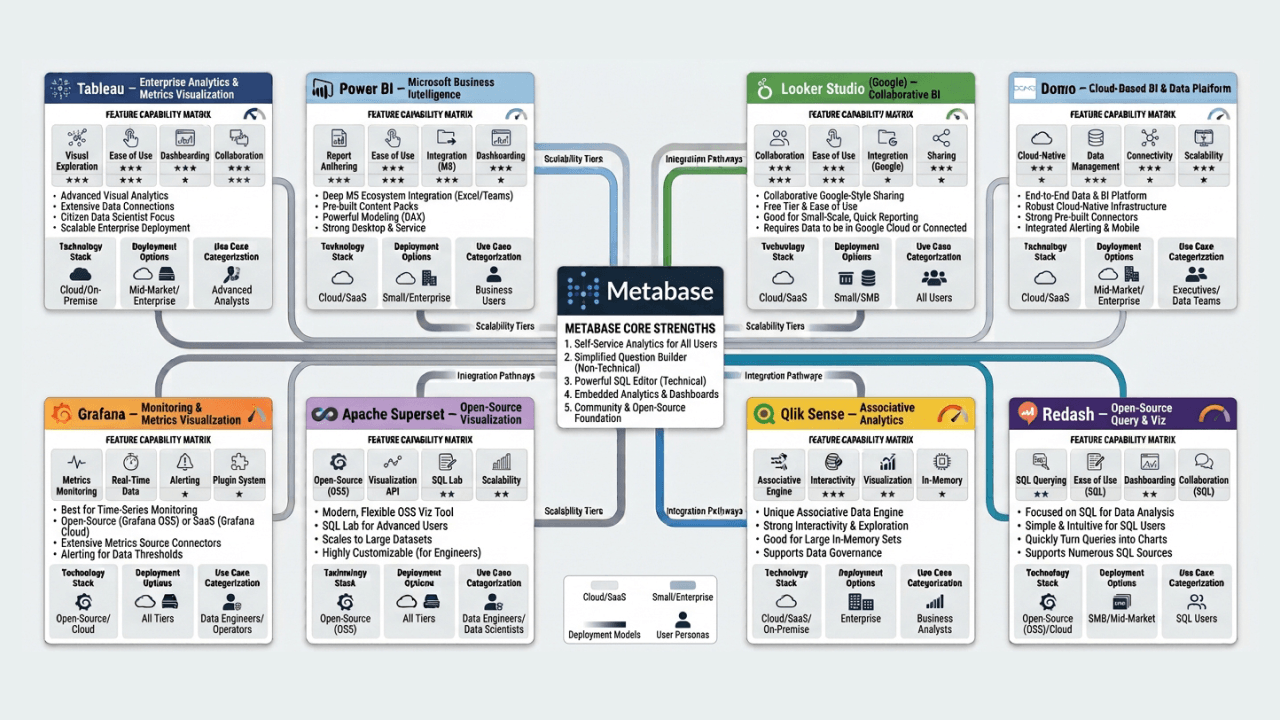
Metabase's free tier can feel limiting once governance requirements surface. Teams find themselves pushed toward platforms with stronger SSO, row-level security, and audit capabilities. This comparison covers eight alternatives ranging from open-source tools like Apache Superset to enterprise suites like Domo and Looker, with clear guidance on which architectural constraints match your operational reality.
The right choice depends on whether you need to upgrade your current setup or move to a platform designed for governed analytics and AI readiness from day one. It's about building the governed data foundation that determines whether your AI investments pay off.
Quick summary of Metabase alternatives
Metabase works beautifully for early-stage data exploration. Teams typically outgrow it when they hit strict requirements for single sign-on (SSO), row-level security (RLS), or multi-tenant embedding at scale.
Metabase alternatives tend to fall into two camps: enterprise platforms (for stronger governance and broader rollout) and open-source options (for teams that want code-level control and can own the operational work). Your choice depends on whether you want to upgrade your current instance or move to a platform built for governed analytics from the start.
Every platform has architectural constraints. The checks below can help narrow the list early:
- Apache Superset: Consider it if you have engineering capacity for infrastructure, upgrades, and security patching.
- Domo: Consider it if you want governed analytics plus automation and agent-driven workflows, especially when multiple teams need consistent access controls.
- Lightdash: Skip if your organization doesn't currently use dbt for data transformation.
- Looker: Consider it if you can invest in upfront modeling and want strict metric governance, even if rollout takes longer than dashboard-first tools.
- Microsoft Power BI: Skip if your company operates primarily on Google Cloud or AWS.
- Sisense: Skip if your primary goal is internal executive dashboards rather than customer-facing embedded analytics.
- Tableau: Skip if you want to distribute insights widely but have a strict budget.
- ThoughtSpot: Skip if your underlying data warehouse is messy or poorly modeled.
{{custom-cta-1}}
Top 8 Metabase alternatives
Tableau
Visual storytelling. That's where Tableau shines. The platform built its reputation on deep chart customization and interactive dashboard design, and teams prioritizing executive presentations often land here.
It connects to a wide range of data sources and offers extensive formatting options. Salesforce ecosystem integration runs deep. The global talent pool of trained Tableau analysts makes hiring easier than with niche tools.
Here's what trips people up: Tableau requires Tableau Server or Tableau Cloud to manage governance features like row-level security. The platform lacks a built-in semantic layer, so teams must rely on external tools to maintain metric consistency. Licensing costs often scale with per-person named licenses, which can strain budgets when organizations try to distribute insights broadly.
Microsoft Power BI
If your company already runs on Azure, Microsoft 365, and Teams, Power BI is often one of the first tools to evaluate. Native integration can shorten setup and adoption time for Microsoft-centric organizations.
The platform uses Data Analysis Expressions (DAX) for complex calculations and offers DirectQuery for near-real-time warehouse connections. Copilot AI assistance helps with report generation. The interface feels familiar to anyone comfortable with Excel.
Advanced governance features like row-level security and deployment pipelines require Premium capacity pricing. Teams operating outside the Microsoft ecosystem frequently find connector configuration more complex than necessary. DAX also presents a steep learning curve for analysts accustomed to standard SQL. Don't underestimate the ramp-up time when planning your migration timeline.
Looker
Semantic layer first. That's Looker's entire philosophy.
All business logic must be defined in LookML before anyone can build dashboards or explore data. This centralized modeling layer ensures every department reports the exact same numbers for core business metrics. Strong native integration with Google Cloud Platform and BigQuery makes it a natural fit for Google Cloud teams. The version-controlled code environment appeals to analytics engineering teams.
LookML requires dedicated analytics engineering resources to build and maintain. Implementation timelines stretch significantly longer than dashboard-first tools because the data model must be perfected before visualization begins. Teams migrating from Metabase often underestimate the time required to rebuild SQL-based questions into a strict semantic layer. Plan for several months of modeling work before the first production dashboard goes live. That timeline often surprises teams that haven't implemented a semantic-layer-first tool before.
ThoughtSpot
What if business teams could just ask questions about their data? ThoughtSpot built its entire product around that premise. The platform translates natural language queries into SQL and instantly generates appropriate charts through a search bar interface.
SpotIQ AI insights automatically detect anomalies and trends. The search-based interface lowers the barrier to entry for business teams. Strong enterprise governance includes SSO, RLS, and audit logs.
But the search interface only works effectively if the underlying data layer is perfectly modeled and clean. Messy data yields confusing search results (and frustrated business teams who lose trust in the tool entirely). Pricing reflects enterprise positioning and may exceed mid-market budgets.
Sisense
Product teams building analytics into SaaS applications often choose Sisense. The platform focuses on delivering analytics inside other applications rather than serving as a standalone internal portal.
Deep white-labeling capabilities help teams match the analytics experience to their product's UI. Multi-tenancy architecture isolates customer data securely. In-chip processing technology accelerates query performance.
The strongest value is embedded analytics for customers. Teams needing primarily internal executive dashboards will likely find other tools simpler to deploy.
Apache Superset
Fast. Lightweight. Free to use.
Apache Superset connects to most SQL-speaking databases under an Apache 2.0 license that allows deep code customization. A SQL-first interface appeals directly to technical data analysts. The active open-source community constantly adds new database connectors. Managed cloud options via Preset help teams avoid infrastructure work.
Self-hosted deployments require your team to own infrastructure, security patching, and version upgrades. The platform lacks a built-in semantic layer, so you must rely on external tools like dbt for metric consistency. Enterprise governance features like SSO require additional manual configuration.
A free open-source license doesn't equal a free analytics program. This pattern comes up often when teams compare "free" tools against the ongoing operational burden.
Lightdash
Your dbt project becomes your BI layer. Lightdash connects directly to existing data models and turns them into interactive dashboards, ensuring that metrics defined in your transformation layer match exactly what appears on screen.
Native dbt integration eliminates the need for a separate semantic layer. The metrics-as-code approach allows version control and peer review. An open-source core provides flexibility with a managed cloud option available.
The entire value proposition depends on having an existing, mature dbt adoption. Teams without dbt workflows need to adopt that stack first. That's a significant prerequisite, not a minor configuration step. Enterprise governance features remain newer compared to legacy platforms.
Domo
Domo is an agentic platform for the intelligent enterprise. It connects, prepares, and distributes data through a single governed environment. The platform is unified by design but modular by adoption, so teams can start with one product (like Domo BI or Data Integration) and expand as needs grow.
The architecture operates across three layers:
- Foundation: Pre-built connectors bring data into your cloud data platform (for example, Snowflake, BigQuery, or Databricks) and standardize it with governed definitions so it's ready for analytics and AI without rebuilding everything from scratch.
- Activation: AI agents and no-code apps work on governed context. People set objectives, constraints, and approval steps, and agents execute within those boundaries.
- Distribution: Outcomes reach people through mobile apps, embedded analytics, AI assistants, and automated workflows rather than just static dashboards.
Role-based access, single sign-on, SCIM provisioning, row-level security, and audit logs run across every layer, from ingestion through agents to delivery.
Teams seeking a point solution for visualization alone may find Domo's unified platform more capability than they need initially. Modular adoption means starting with one product (like BI or Data Integration) is a valid entry point.
{{custom-cta-2}}
How to choose a Metabase alternative
Selecting a new analytics platform requires matching your operational constraints to the architectural realities of the tool. The right choice depends on whether your primary constraint is governance requirements, time-to-value, technical capacity, or budget structure.
Start with governance. If your organization needs single sign-on (SSO), System for Cross-domain Identity Management (SCIM) provisioning, row-level security, column-level security, or audit logs, evaluate this feature set first. Compliance or multi-tenant embedding makes governance non-negotiable.
Teams experiencing metric drift across departments should prioritize tools with enforced semantic layers like Looker or Domo. Teams with mature dbt workflows may prefer tools that consume dbt metrics directly.
Self-hosted open-source tools reduce licensing costs but add infrastructure, security, and upgrade burdens. SaaS shifts that burden to the vendor but introduces data residency and vendor lock-in considerations.
If analytics will live inside customer-facing products, evaluate multi-tenancy architecture, white-labeling, and embedding software development kits (SDKs). If distribution remains internal, evaluate mobile apps, chat integrations, and automated alerting.
Teams planning to deploy AI agents or copilots on business data must evaluate whether the platform makes data AI-ready with governed context. McKinsey found that 80 percent of companies cite data limitations as a roadblock to scaling agentic AI. This finding underscores why governance isn't optional: ungoverned AI experimentation environments create massive security risks and stall projects before they deliver value.
License fees represent only one input of total cost. Add implementation time, training, infrastructure hosting, and ongoing maintenance to calculate the true financial impact.
Migrating away from Metabase takes planning to move existing questions, dashboards, and permission rules. Exporting saved questions and dashboards is possible but highly manual. Prioritize platforms with SQL-based definitions that can be stored in version control (for example, Git) to make migrations and reviews easier.
Teams often struggle during evaluations when they choose based on feature lists and don't test governance in a proof of concept. Use your actual permission structure, not a simplified demo setup. Always test row-level security during your proof of concept using an actual role hierarchy from your organization.
Sometimes staying put makes the most sense. If your Metabase limitations center primarily around SSO and RLS, and your team is small with no embedding requirements, upgrading to Metabase Pro often proves simpler than migrating entirely.
Quick decision shortcuts based on your situation:
- For low maintenance and strong AI readiness: Choose Domo. It helps teams activate governed data through agents, apps, and automation, with human oversight and access controls built in.
- For teams with existing dbt workflows: Choose Lightdash. It integrates natively with your current metrics-as-code setup.
- For Microsoft-centric environments: Choose Power BI. Native integration with Azure and Teams provides the fastest time-to-value.
- For engineering-heavy teams wanting open source: Choose Apache Superset. It provides deep customization and reduces dependency on a single vendor, provided you have staff to maintain infrastructure.
If you're ready to sanity-check governance (single sign-on, SCIM provisioning, row-level security, audit logs) and see what "AI-ready" looks like in day-to-day workflows, not just a feature list, get a demo and talk through patterns that reduce migration effort and keep analytics access controlled.
Key takeaways
- Metabase's free tier can feel limiting once governance requirements like SSO, row-level security, and audit logs become non-negotiable.
- Enterprise platforms like Domo and Looker prioritize governed analytics and AI readiness, while open-source tools like Apache Superset offer code-level control for teams with engineering capacity.
- Start your evaluation with governance features (SSO, SCIM, row-level security, audit logs) if compliance or multi-tenant embedding is required.
- Test row-level security during your proof of concept using your actual role hierarchy, not a simplified demo setup.
- Total cost includes license fees, implementation time, training, infrastructure hosting, and ongoing maintenance, not just the platform subscription.