Top 7 IBM Cognos Alternatives for 2026: A Complete Comparison

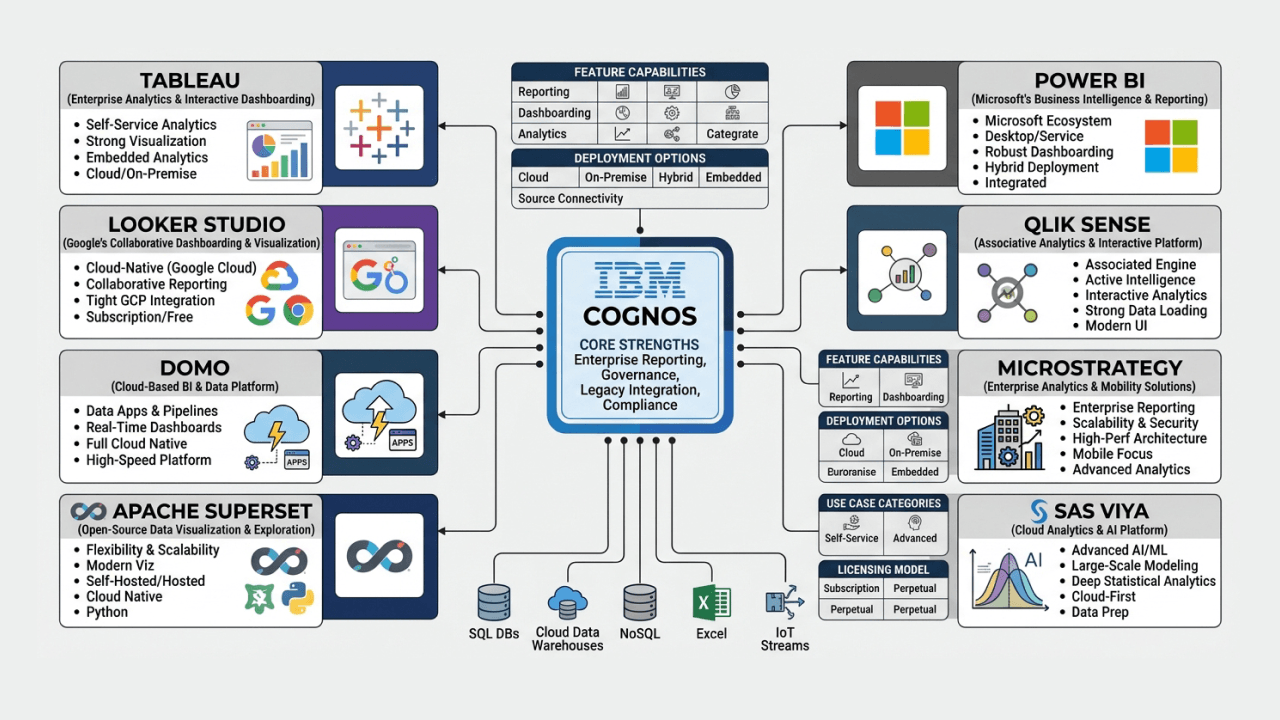
Replacing IBM Cognos requires more than a feature checklist. Teams should understand how hard the semantic layer will be to migrate. You'll also have to evaluate AI integration and audit how insights will reach people outside of email and portal links. This comparison covers seven platforms, from Power BI and Tableau to Domo and ThoughtSpot, with specific guidance on where each tool excels and where Cognos migration gets complicated.
Key takeaways
Cognos migrations stall not because alternatives lack features, but because teams underestimate how much business logic lives inside Framework Manager packages. That semantic layer (where you define query subjects, filters, and calculations) rarely transfers cleanly to a new platform.
- Semantic layer rebuild time: Teams with complex Framework Manager packages containing hundreds of query subjects should budget weeks or months for rebuilding that logic in the new tool's data model.
- Bursting gaps: If your organization delivers hundreds of per-recipient reports nightly, audit whether alternatives support native scheduled distribution or require third-party orchestration.
- AI integration limits: Cognos governance stops at the report layer. Teams funding AI copilots need platforms where governance extends from data ingestion through agent outputs.
- Distribution friction: Email and portal links work fine until insights need to reach Slack, Teams, or embedded customer portals. Modern tools vary widely here.
Quick summary of top IBM Cognos alternatives
Here's a quick snapshot of where each option tends to fit, so you can narrow your short list.
- Domo: best for teams that need AI agents operating on governed data with distribution into existing workflows
- Microsoft Power BI: best for Microsoft-centric environments with existing M365 investment
- Tableau: best for advanced visualization and exploratory analysis
- Qlik Sense: best for associative exploration across complex data relationships
- Looker: best for semantic modeling in Google Cloud environments
- Amazon QuickSight: best for AWS-native BI with serverless scaling
- ThoughtSpot: best for search-driven analytics for business users
Use this table for a side-by-side scan, then read the tool sections for migration details.
Cognos parity refers to pixel-perfect reporting, report bursting, and semantic layer support.
Why teams replace IBM Cognos today
Scheduled reports still run. But the backlog of change requests? It grows faster than IT can address them.
Three triggers force the conversation. First, teams funding AI copilots or agents find Cognos lacks native integration points for large language model (LLM) assistants. When AI budget exists but data isn't accessible to agents, the gap becomes urgent. Second, as more teams move from AI experiments to production, they need governance that extends from data ingestion through agent outputs. Cognos governance stops at the report layer. Third, when insights need to reach Slack, Teams, mobile apps, or embedded portals, the email-and-portal distribution model creates friction.
That said, if pixel-perfect paginated reports with complex bursting schedules represent the majority of your output, and no AI or embedded distribution requirements exist, Cognos may still be the right fit.
{{custom-cta-1}}
Top 7 IBM Cognos alternatives
These tools span different architectural approaches. The right choice depends on where your data lives, how much governance logic needs to migrate, and whether AI agents or embedded distribution are on the roadmap.
Domo for AI agents and governed distribution
Domo is an agentic platform for the intelligent enterprise. Unified by design, modular by adoption. It connects, prepares, and governs data across common cloud data platforms and business systems, then supports AI agents and apps that operate on governed context with human-in-the-loop oversight.
Mid-market to enterprise teams with AI budgets that need data and distribution they don't have yet often select Domo. Outcomes reach people through mobile apps, embedded analytics, AI assistants, and automated workflows.
- Bounded autonomy: Humans set objectives and constraints; machines execute within those boundaries.
- End-to-end governance: Role-based access carries from data ingestion through AI agent outputs.
- Complementary architecture: Runs on top of existing cloud data platforms like Snowflake and Databricks rather than replacing them.
Cognos parity is partial. Domo supports governed metrics and row-level security, but pixel-perfect paginated reports require design adjustments. Bursting-style distribution is handled through automated alerts and scheduled delivery to multiple channels. Framework Manager semantic logic requires mapping to Domo's data model, and that mapping is where many teams underestimate the effort.
Teams whose primary output is pixel-perfect paginated reports may find the card-based layout model unfamiliar.
Microsoft Power BI for Microsoft-centric analytics
Power BI is Microsoft's analytics platform, tightly integrated with Azure, Excel, and Microsoft 365. Organizations with existing Microsoft 365 (M365) and Azure investments frequently evaluate it first.
Interactive dashboards. Paginated reports via Report Builder. Integration with Microsoft Fabric. Copilot features can support natural language queries when your environment is set up for them, typically with Premium capacity.
- Cost efficiency: Strong price-to-performance ratio for organizations already paying for Microsoft licensing.
- Reporting parity: Paginated Reports provide pixel-perfect output comparable to Cognos Report Studio.
- Security integration: Row-level security integrates directly with Active Directory.
Cognos parity is high via Paginated Reports. It supports pixel-perfect layouts, parameters, and scheduled distribution. Bursting requires Power Automate or third-party orchestration for per-recipient customization.
Organizations without Microsoft 365 investment face higher friction. Premium capacity licensing adds cost for advanced features.
Tableau for advanced data visualization
Salesforce's visualization platform. Known for drag-and-drop exploration. Teams prioritizing exploratory analysis and data storytelling over pixel-perfect operational reporting often choose it.
The software offers interactive dashboards, natural language queries through Ask Data, and deep Salesforce CRM integration. Tableau Pulse provides AI-driven insights summaries.
- Visual exploration: Intuitive drag-and-drop interface for building complex visualizations.
- Ecosystem support: Strong community and extensive training resources.
- CRM alignment: Deep Salesforce integration for sales and marketing analytics.
Cognos parity is partial. Tableau excels at interactive dashboards but lacks native pixel-perfect paginated report capabilities. Bursting requires Tableau Server with subscriptions or third-party tools.
Teams with heavy paginated reporting requirements will find the layout model limiting.
Qlik Sense for associative exploration
What if your people could explore data relationships in any direction without predefined query paths? That's Qlik Sense's promise. Its proprietary associative engine reveals hidden relationships across data silos, though this flexibility means teams accustomed to structured Cognos queries may need time to adjust their mental model.
Organizations with complex, interconnected data sources evaluate Qlik when people need to explore relationships freely. The in-memory engine indexes all data relationships for on-the-fly discovery.
- Data discovery: The associative engine exposes connections that traditional query-based BI tools miss.
- Assisted analysis: Insight Advisor provides AI-assisted chart generation.
- Deployment flexibility: Hybrid options support both cloud and on-premises environments.
Cognos parity is partial. Pixel-perfect paginated reports require the NPrinting add-on, which adds licensing cost and complexity.
Looker for semantic modeling in the cloud
Google Cloud's BI platform, built around LookML. A semantic modeling language that ensures metric consistency. It separates business logic from visualization.
Organizations with Google Cloud infrastructure that prioritize governed, consistent metrics frequently select Looker. It appeals strongly to data engineering teams (and if you've ever had to debug a dashboard where "revenue" meant three different things depending on who built it, you'll understand why).
- Metric consistency: LookML enforces strict metric consistency across all outputs.
- Cloud native: Native BigQuery integration with efficient in-database processing.
- Version control: Git-based version control manages all data models.
Cognos parity is partial. The semantic layer is strong and comparable to Framework Manager packages. Pixel-perfect paginated reports aren't native.
Organizations outside Google Cloud face higher friction.
{{custom-cta-2}}
Amazon QuickSight for AWS-native BI
QuickSight is Amazon Web Services' (AWS) serverless BI service, designed for pay-per-session pricing. It scales automatically without infrastructure management.
Organizations with AWS infrastructure like Redshift, S3, and Athena evaluate QuickSight when they want BI without managing servers.
- Usage pricing: Pay-per-session benefits organizations with occasional users.
- AWS alignment: Native integration with Redshift, S3, Athena, and SageMaker.
- Conversational queries: Q allows natural language questions.
Cognos parity requires workarounds. Pixel-perfect paginated reports require export to PDF or third-party tools. Bursting-style distribution requires Lambda or Step Functions orchestration. QuickSight focuses on core dashboarding and embedded analytics patterns. Teams that need a broad set of paginated reporting and bursting features often add orchestration or third-party tooling.
ThoughtSpot for search-driven analytics
A search-first analytics platform. People query data using natural language rather than building reports. The Spotter AI agent provides generative AI-powered insights.
Organizations prioritizing self-service analytics for business people who want answers without learning BI tools often choose ThoughtSpot.
- Accessible interface: Natural language search lowers the barrier for non-technical users.
- Conversational AI: Spotter enables conversational analytics and automated insights.
- Warehouse integration: Strong integration with Snowflake, BigQuery, and Databricks.
Cognos parity requires workarounds. The platform is designed for ad-hoc exploration, not paginated operational reports.
Scope and neutrality note
This list isn't exhaustive, and the tools aren't ranked. It reflects editorial judgment based on common enterprise evaluation patterns, and product capabilities change over time.
How to evaluate IBM Cognos alternatives
Teams often evaluate alternatives by comparing feature lists without auditing how much governance logic lives in Cognos packages and prompts. The result: a tool that demos well but requires months of rebuilding.
Take your most complex Framework Manager package with cascading prompts and ask the vendor to map it to their semantic layer during the proof of concept. If they can't replicate the logic without hundreds of lines of custom code, the migration timeline will stretch. A common assumption is that a tool with a "semantic layer" will automatically interpret existing Framework Manager logic. It won't. Each platform's semantic model has its own structure, and the translation requires deliberate mapping.
Evaluate platforms against these acceptance criteria:
- Cognos artifact parity: Does the tool support pixel-perfect paginated reports, parameterized prompts, and scheduled bursting?
- Semantic layer migration: Can Framework Manager packages map to the new semantic model, or does business logic require rebuilding?
- Governance continuity: Does row-level security transfer? Are audit logs and lineage available?
- AI readiness: AI agent roadmaps are moving quickly across the market. If governed access for AI is on your roadmap, treat it as a core evaluation criterion so you don't have to re-platform later. Does the tool support AI assistants or agents that can access governed data?
- Distribution model: Where do insights need to land? Email, portals, mobile, Slack, embedded apps?
- Licensing model: Viewer/creator splits, capacity-based pricing, and pay-per-session models affect total cost differently depending on user mix.
Demo polish matters less than governance parity and migration complexity.
IBM Cognos vs Power BI, Tableau, and Qlik
IBM Cognos vs Microsoft Power BI: Power BI wins on lower licensing cost for Microsoft 365 organizations and Copilot AI features. Cognos stays ahead on native pixel-perfect paginated reports without add-ons and established bursting workflows. If bursting schedules deliver hundreds of per-recipient reports nightly, audit Power Automate's orchestration limits before committing.
IBM Cognos vs Tableau: Tableau wins on visual exploration depth and community resources. Cognos stays ahead on paginated operational reports and pixel-perfect layouts. If pixel-perfect paginated output is the primary deliverable, Tableau's layout model requires significant redesign.
IBM Cognos vs Qlik Sense: Qlik wins on associative exploration and in-memory performance. Cognos stays ahead on native paginated reports and the Framework Manager semantic layer. NPrinting is required for Cognos-style paginated output, adding licensing cost.
Choosing the right IBM Cognos alternative
Three factors matter most: where your data lives, how much governance logic needs to migrate, and whether AI activation or embedded distribution are on the roadmap.
If Microsoft 365 and Azure are the foundation, Power BI offers the lowest friction path. If exploratory visualization matters more than operational reports, Tableau delivers depth but requires paginated report redesign. If Google Cloud and governed metrics are central, Looker's LookML maps well to Framework Manager concepts.
If AI agents and workflow distribution are priorities, Domo provides governed activation and distribution without replacing existing cloud data platforms. Get a demo to see what a Cognos migration looks like when semantic logic, governance, and delivery channels are designed in from day one.