Generative AI vs Predictive AI: What's the Difference and When to Use Each

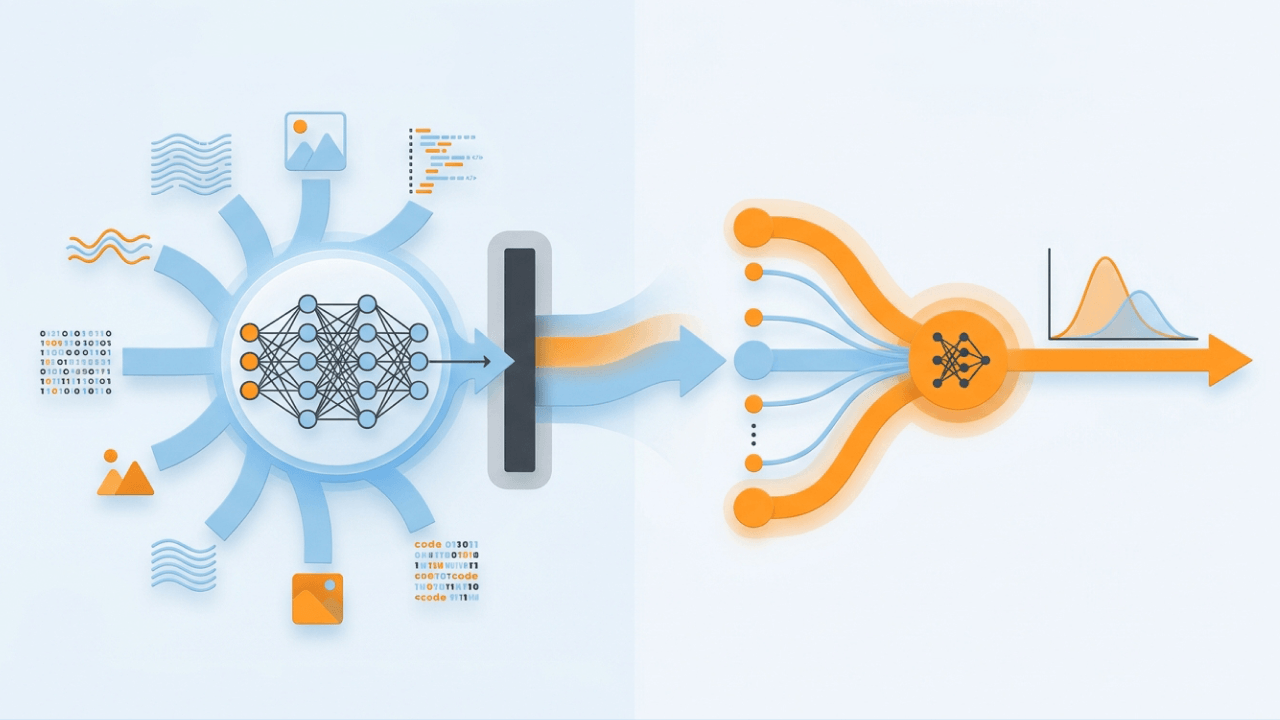
Generative AI and predictive AI solve fundamentally different problems. One produces text, images, and code that are new. The other scores probabilities and forecasts quantities, values, or numbers based on historical patterns. This article explains the core differences in how they work, what they output, and how enterprise teams combine them in practice.
Key takeaways
Here are the main differences to keep in mind:
- Predictive AI forecasts outcomes: It analyzes historical data to answer "what will happen next" with a probability score, category, or number.
- Generative AI outputs new content: It learns patterns from massive datasets to produce text, images, code, or audio that didn't exist before.
- Different data requirements: Predictive models need labeled, structured data while generative models train on unstructured content at massive scale.
- Many workflows combine both: A predictive model identifies at-risk customers while a generative model drafts the retention message.
Generative AI vs predictive AI at a glance
What is generative AI?
When you ask ChatGPT to write an email or DALL-E to create an image, you're using generative AI. These systems learn patterns from large datasets and produce new content (text, images, code, or audio) that didn't exist in the training data.
Many enterprise generative applications use foundation models such as GPT, Claude, and Gemini. Stanford's The 2025 AI Index Report | Stanford HAI2025 AI Index reports $33.9 billion in private investment in 2024 alone. That figure signals where enterprise budgets are heading. These models train on billions of text files, images, or audio samples. Your organization doesn't train these models from scratch. Instead, you connect them to your business data through techniques like retrieval-augmented generation (RAG) or fine-tuning.
The outputs are probabilistic. Run the same prompt twice and you'll get slightly different results each time.
What is predictive AI?
"Will this customer churn?" "Is this transaction fraudulent?" Predictive AI answers these questions with a specific probability, category, or number, using machine learning models trained on labeled historical data.
This is the more mature category of enterprise AI. Most machine learning deployments today (churn scores, demand forecasts, fraud detection) fall into this bucket. The models include decision trees, gradient boosting like XGBoost and LightGBM, logistic regression, and neural networks for tabular data.
Predictive outputs are typically deterministic at inference time. Same input, same result.
{{custom-cta-1}}
Core differences between generative and predictive AI
A retail team wants to reduce churn and personalize outreach. Predictive AI identifies which customers are likely to leave. Generative AI drafts the personalized message to retain them. Same workflow, two different AI types, completely different mechanics.
Training data requirements
Predictive AI requires labeled, structured data. Rows and columns with a known outcome. Did this customer churn? Was this transaction fraud? If your organization lacks clean historical labels, predictive projects stall before they start. This is where many teams get stuck: they assume they have labeled data when they actually have inconsistent or incomplete outcome tracking, which undermines model accuracy from day one.
Generative AI trains on massive unstructured datasets at scales only model providers can manage. Enterprise teams don't train foundation models. They fine-tune them or prompt them with business context through RAG.
Predictive projects depend on your internal data quality. Generative projects depend on connecting external models to your internal knowledge bases. Both need governed data pipelines, but the bottleneck is different.
Output types and formats
Predictive AI delivers a specific answer: an 87 percent churn probability, a "high risk" category, a $42,000 revenue forecast. Teams evaluate these models using established metrics like AUC-ROC (area under the receiver operating characteristic curve), precision, and recall.
Generative AI produces new content. A paragraph. An image. A code snippet. Evaluation is harder because there's no single "correct" answer, which means it often requires human review or domain-specific rubrics.
Models and architectures
Predictive models run efficiently on internal infrastructure with modest compute. A gradient boosting model can score thousands of records per second.
Generative models rely on transformer architectures that are computationally expensive. Most organizations access them through application programming interfaces (APIs) from model providers, which introduces cost-per-token and latency considerations. If you're planning real-time generative use cases, factor in API response times.
Generative AI use cases
Teams often deploy a chatbot without connecting it to governed business data. The result? A system that confidently invents product features or misstates company policy. The fix isn't abandoning the technology. It's grounding the model in accurate, up-to-date context.
Content and personalization
Marketing teams use generative AI to draft ad copy, email subject lines, or landing page variants at scale. What took a copywriter hours now takes minutes.
Without guardrails, the model may produce off-brand language or invent product features. Teams that succeed define prompt templates, connect the model to approved product data, and route outputs through human review before publishing. When review processes lag behind adoption, brand and compliance risks increase. When tolerance for error is low, generative drafts serve as starting points, not final outputs.
Chatbots and AI assistants
Customer-facing chatbots and internal knowledge assistants are among the most common generative deployments. The model retrieves relevant context through RAG and generates a conversational response.
Hallucination remains the primary failure mode. If the retrieval step returns incomplete or outdated information, the model fills gaps with plausible-sounding but incorrect answers. Organizations with strict accuracy requirements implement confidence thresholds, escalation to human agents, and detailed audit logs.
Code generation and document summarization
Developers use generative AI to suggest code snippets or automate boilerplate. The model accelerates iteration, though every suggestion requires developer review before committing. Blindly accepting generated code (especially for security-sensitive functions) introduces vulnerabilities that automated testing may not catch.
Document summarization condenses reports, contracts, or support tickets into actionable summaries. This works well when the source documents are accurate and the model is constrained to cite rather than improvise.
Predictive AI use cases
A demand forecasting model trained on pre-pandemic data produces wildly inaccurate predictions when market patterns shift. The fix isn't abandoning predictive AI. It's monitoring for model drift and retraining on recent data.
Forecasting and demand planning
Forecasting models predict numeric outcomes: next quarter's revenue, next week's demand, next month's inventory needs. They depend entirely on feature freshness.
Teams that succeed implement monitoring dashboards that track prediction accuracy over time and trigger retraining when performance degrades. More frequent retraining improves accuracy but increases compute and engineering overhead.
Churn prediction and risk scoring
Risk scoring models sort entities into categories. High, medium, or low risk. Churn models score customers by likelihood to leave so teams can prioritize retention outreach.
These models offer a major governance advantage: techniques like SHapley Additive exPlanations (SHAP) values help data teams understand which factors contributed most to a specific high-risk score. This is especially valuable in industries like financial services or healthcare, where "because the model said so" doesn't satisfy regulators.
Fraud detection
Fraud detection flags anomalous transactions in real time for review.
False positives create friction for legitimate customers. False negatives let fraud through. Teams tune the threshold based on their tolerance for each type of error.
{{custom-cta-2}}
Benefits of generative AI
Generative models offer productivity gains when applied to the right workflows:
- Faster content creation: Drafting time drops significantly when the model handles first versions
- Personalization at scale: Segment-specific messaging becomes feasible without proportional headcount increases
- Knowledge synthesis: Employees find answers faster when assistants surface relevant documentation
- Multimodal flexibility: A single model can handle text, images, or code depending on the use case
These benefits compound when outputs are grounded in governed data and routed through appropriate review workflows.
Benefits of predictive AI
Predictive models excel at automation and measurement:
- Deterministic outputs: Same input produces same result, enabling consistent automation
- Explainability: SHAP values show which features drove a prediction
- Low latency: Models run efficiently, enabling real-time scoring at scale
- Clear evaluation: Metrics like AUC, precision, and recall provide objective performance benchmarks
These benefits hold as long as models are monitored for drift and retrained on fresh data.
When to use generative AI vs predictive AI
Teams often ask which technology is better. Wrong question. The real question is which fits the task.
Choose predictive AI when you need to automate high-volume decisions, flag risks, or forecast numbers based on historical patterns. Choose generative AI when you need to synthesize large amounts of text, draft personalized communications, or build conversational interfaces.
Many workflows combine both. A predictive model identifies which customers are at risk; a generative model drafts the retention message. A predictive model scores leads; a generative assistant summarizes the account history for the sales rep.
If you're chaining these models together, map out the total round-trip latency before committing. A predictive model might score in 50 milliseconds, but a generative model might take eight seconds to write the summary. That gap determines whether your workflow can operate in real time. In practice, this latency question is what kills otherwise promising architectures.
How Domo supports both generative and predictive AI
Both generative and predictive AI need the same thing: governed, AI-ready data and a way to deliver results into your workflows. Many organizations struggle with disconnected data, inconsistent governance, and no clear path to get AI insights to the people who need to act on them.
Domo's unified, modular platform solves this with three layers:
- Foundation Layer: Connects and governs all your enterprise data, preparing it for both predictive models and generative AI.
- Activation Layer: Ensures AI agents and apps use governed information. It includes human review for predictive models (scoring, classifying) and generative agents (drafting, summarizing), all with consistent access controls.
- Distribution Layer: Delivers AI outcomes directly into existing workflows via mobile apps, embedded analytics, AI assistants, and automated alerts.
Domo works with your current cloud data platform and preferred inference models (OpenAI, Anthropic, Google, or your own). We orchestrate, not provide, the models. Our AI agents operate with defined autonomy: humans set the goals and limits, and machines execute within those boundaries.
Ready to put both AI styles to work on the same governed data foundation without duct-taping tools together? Get a demo.