Boomi Alternatives: 8 Platforms for AI-Ready Data

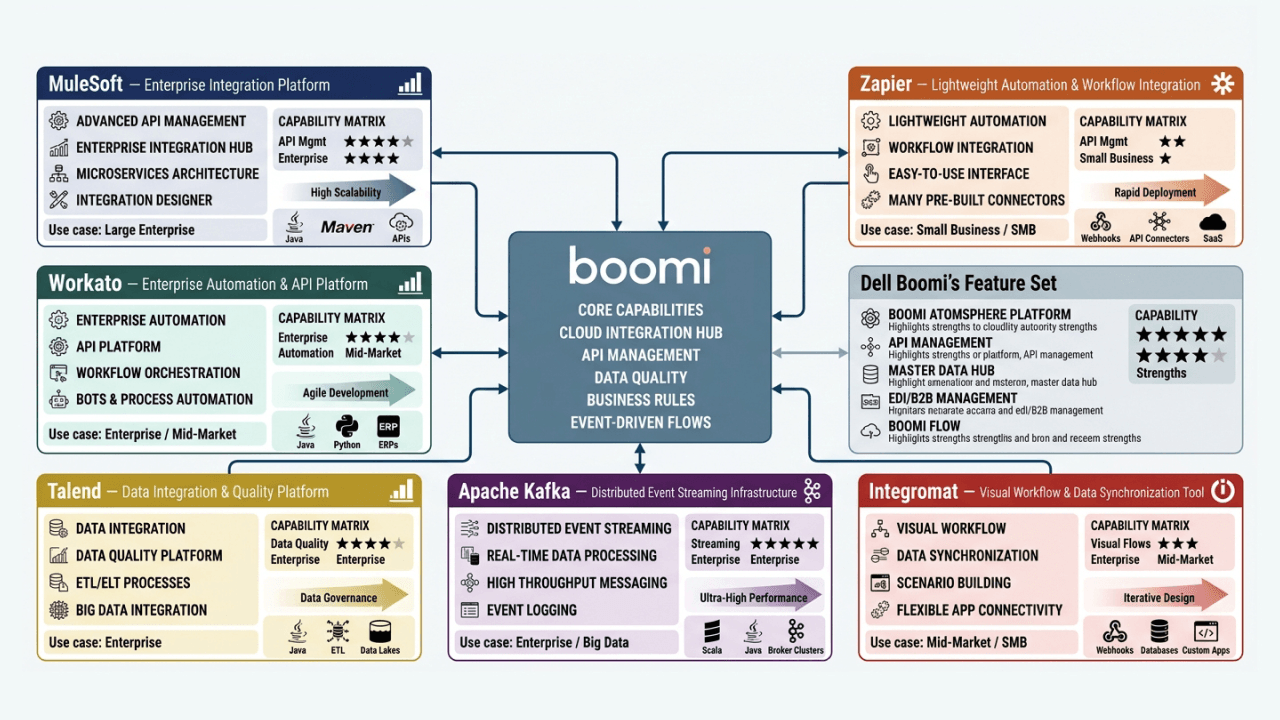
Teams evaluating Boomi alternatives typically run into three friction points: unpredictable pricing as integrations multiply, governance gaps when data needs to support AI workflows, and hybrid deployment complexity. This guide compares eight platforms across iPaaS, automation, and unified data categories to help you find the right fit for your architecture and goals.
Key takeaways
Boomi is a capable iPaaS (integration platform as a service), but teams evaluating alternatives typically hit one of three walls: unpredictable pricing at scale, limited flexibility for AI-driven workflows, or governance gaps when the data needs to power analytics and automated workflows.
- Governance scope matters more than connector count: Forrester reports governance is increasingly urgent for companies deploying AI agents. Prioritize platforms where role-based access extends from ingestion through activation, not just the integration layer.
- Runtime topology determines hybrid success: Teams with on-prem requirements should verify whether the platform's agent model (Atom, Snaplex, Secure Agent) matches their network topology before demoing.
- Pricing models diverge dramatically: Connection-based, task-based, and consumption-based models all exist. Map your expected data volume and sync frequency to each model before comparing sticker prices.
Quick summary of top Boomi alternatives
When a data team outgrows Boomi (or never needed its full weight), the shortlist narrows to platforms that trade off breadth, governance, and ease of adoption differently. Here are eight alternatives to Boomi and what they are best for:
- Domo: for teams that need governed data ready for AI agents and embedded analytics
- MuleSoft Anypoint Platform: best for API-led connectivity programs with dedicated integration teams
- Workato: best for business-team-built automations spanning IT and operations
- SnapLogic: best for visual pipeline building across hybrid environments
- Informatica IDMC: best for complex enterprise data governance and master data management
- Microsoft Azure Logic Apps: best for organizations standardized on the Microsoft ecosystem
- Tray.io: best for operations teams needing flexible, multi-department workflows
- Jitterbit Harmony: best for mid-market teams needing fast deployment with pre-built templates
* List order reflects editorial structure, not ranking.
Scope and neutrality note: This list isn't exhaustive, and the tools aren't ranked. It reflects editorial judgment based on common buyer evaluation patterns, and platforms change over time as features and pricing evolve.
{{custom-cta-1}}
What's Boomi and why teams look for alternatives
Boomi is a cloud-native integration platform built around AtomSphere, a distributed runtime that connects SaaS applications, databases, and on-prem systems. It handles ETL (extract, transform, load), API management, electronic data interchange (EDI) and B2B integrations, and workflow orchestration.
Most teams evaluating alternatives aren't starting from scratch. They've either hit a ceiling with Boomi or inherited an integration stack that doesn't fit their current architecture. McKinsey's 2026 survey found 42 percent cite integration as the top barrier to scaling AI. That number alone tells you why platform choice matters so much right now.
The friction points tend to cluster around:
- Pricing unpredictability: Boomi's connection-based model can spike costs as integrations multiply. Teams with high connector counts often find consumption-based or flat-fee models easier to forecast.
- Governance gaps for AI workflows: Boomi moves data between systems, but teams building AI agents need governed data ready for inference. If your AI roadmap requires lineage, role-based access, and activation in one platform, Boomi may be one layer in a multi-tool stack.
- Hybrid complexity: Boomi's Atom runtime handles hybrid deployments, but teams with strict data residency requirements sometimes find agent configuration more cumbersome than alternatives.
Types of Boomi alternatives
Not every "Boomi alternative" is a direct replacement. Some platforms compete head-to-head on iPaaS capabilities. Others solve adjacent problems: API management, ETL/ELT, workflow automation, or unified data platforms that include integration as one layer.
- Full-stack iPaaS: Platforms like MuleSoft and SnapLogic mirror Boomi's breadth across API management, EDI, orchestration, and hybrid runtime. Choose these when you need a single vendor for enterprise integration programs.
- Business-user automation platforms: Workato and Tray.io offer recipe-based, low-code environments designed for operations teams to build automations without engineering tickets.
- ETL/ELT-first platforms: Fivetran, Airbyte, and dbt focus on warehouse loading and transformation, not app-to-app orchestration. Choose these when the primary goal is analytics-ready data.
- Unified data and AI platforms: Domo treats integration as one layer in a platform that also governs, transforms, visualizes, and activates data for AI agents.
These categories overlap. MuleSoft has low-code features. Workato has API management. The question is where the center of gravity sits.
{{custom-cta-2}}
Top 8 Boomi alternatives for data integration
The platforms below represent different approaches to the problems Boomi solves. Each entry covers positioning, best-fit scenario, key strengths, and fit context.
Domo
Integration is one layer in Domo's agentic platform for the intelligent enterprise. Governance, transformation, and AI activation happen in the same environment, with human-in-the-loop controls so people set objectives and constraints and agents execute within those boundaries.
Best for teams that need governed data ready for AI workflows. Not just connected systems, but data that flows from ingestion through activation without rebuilding governance at each step.
Domo connects to cloud apps, databases, and on-prem systems, then governs and transforms the data in a single environment.
- Foundation: make data AI-ready with consistent governance and definitions
- Activation: run AI agents and automations on governed data with human oversight
- Distribution: deliver outcomes into embedded analytics, mobile apps, and the tools people already use
Domo is unified by design and modular by adoption, so teams can start with integration, BI, or apps and expand without redefining governance each time.
- Governance runs from data ingestion through AI agent activation.
- Runs on top of existing cloud data platforms like Snowflake and Databricks rather than replacing them.
- Distribution layer delivers outcomes into mobile apps, embedded analytics, and AI assistants.
Domo is strongest when the goal is governed data ready for AI and analytics. Teams looking for a pure iPaaS to orchestrate B2B EDI or API gateway traffic may find Domo's strengths lie elsewhere.
MuleSoft Anypoint Platform
The enterprise iPaaS most often compared to Boomi. API-led connectivity, full lifecycle API management, and a mature hybrid runtime.
Best for organizations with dedicated integration teams building API-led architectures across complex, multi-system environments.
Anypoint Platform covers API design, integration, and management in a single environment. Runtime Fabric supports hybrid and multi-cloud deployments.
- API-led connectivity model scales for large integration programs
- Strong Salesforce ecosystem integration
- Mature governance and lifecycle management for APIs
MuleSoft assumes a technical integration team. Licensing costs are often higher than alternatives, and implementation timelines can extend for complex deployments. That trade-off often gets missed in side-by-side feature checklists.
Workato
A low-code automation platform designed for business teams to build integrations and workflows without engineering tickets.
Best for revenue operations (RevOps), marketing operations, and finance teams that need to automate cross-functional workflows without waiting for IT.
Workato uses a recipe-based model where people connect apps, define triggers, and build automations visually. The simplicity is the appeal. It can also lead to sprawl if teams don't set governance early. Teams sometimes underestimate how quickly recipe sprawl creates governance blind spots when dozens of automations run without centralized oversight.
- Low-code interface accessible to non-technical users
- Recipe library accelerates common automation patterns
- On-prem agent available for hybrid deployments
Teams with complex data transformation needs or strict governance requirements may need to layer Workato with other tools.
SnapLogic
An enterprise iPaaS with a visual pipeline builder and strong support for hybrid and multi-cloud environments.
Best for data and IT teams that need to build complex integration pipelines with a balance of visual design and technical depth.
SnapLogic's Intelligent Integration Platform uses Snaps (pre-built connectors) and a drag-and-drop pipeline builder. The Snaplex runtime supports cloud, on-prem, and hybrid deployments.
- Visual pipeline builder with technical depth for complex transformations
- AI-assisted pipeline suggestions
- Broad connector library across enterprise apps and databases
SnapLogic sits between low-code and developer-heavy platforms.
Informatica IDMC
Enterprise data management spanning integration, data quality, governance, and master data management (MDM).
Best for large enterprises with complex data governance requirements and multi-domain data management needs.
Informatica Intelligent Data Management Cloud (IDMC) combines ETL, API management, data quality, and MDM in a unified cloud platform.
- Deep data quality and governance capabilities
- Master data management in the same platform
- Broad connector ecosystem for enterprise apps and legacy systems
Informatica is built for enterprise-scale programs. Teams looking for lightweight, fast-to-deploy integration will probably find the platform heavier than needed.
Microsoft Azure Logic Apps and Power Automate
Microsoft's integration tools (Logic Apps for developers, Power Automate for business teams) are native to the Azure and Microsoft 365 ecosystem.
Best for organizations already standardized on Microsoft Azure and Microsoft 365 that want integration without adding another vendor.
Logic Apps provides serverless, event-driven integration. Power Automate offers low-code automation for business users.
- Native Azure and M365 integration
- Serverless, consumption-based pricing for Logic Apps
- Deep integration with Dataverse, SharePoint, and Teams
Teams with significant non-Microsoft infrastructure may find connector depth and performance uneven. You'll notice this most acutely when trying to integrate legacy systems or niche SaaS apps.
Tray.io
General automation combining low-code workflow building with developer-friendly extensibility. More flexible than it first appears.
Best for operations teams that need automation flexibility beyond simple app-to-app sync.
Tray uses a visual workflow builder with connectors, logic operators, and the ability to call APIs directly.
- Visual builder with API-level flexibility for custom logic
- Connectors for common SaaS apps plus universal HTTP/REST
- Scales from simple automations to complex, multi-step workflows
Jitterbit Harmony
Speed to deployment is the pitch here. You get a visual designer, pre-built templates, and pricing that's often easier to forecast for mid-market budgets.
Best for mid-market teams that need to connect SaaS apps and databases quickly without a large integration team.
Harmony combines a cloud-based design studio with on-prem agents for hybrid deployments.
- Visual designer with pre-built templates for common use cases
- Competitive pricing relative to MuleSoft and Informatica
- API management capabilities included
Teams with very complex, large-scale integration programs may find it less mature than enterprise alternatives.
How to choose a Boomi alternative
Most teams start by comparing connector counts and pricing tiers. The platforms that look similar on a feature matrix often diverge on implementation complexity, governance depth, and who actually builds and maintains integrations.
Who builds and owns integrations: Some platforms assume a dedicated integration team. Others are designed for business users. If your integration backlog is driven by RevOps or Finance, a low-code platform may clear it faster.
Hybrid and on-prem requirements: All major platforms offer some hybrid capability, but agent models differ. Hybrid architecture makes runtime topology a strategic decision, not just a technical one. Verify whether the platform's runtime matches your network topology and data residency requirements before demoing.
Governance and AI-readiness: If your roadmap includes AI agents or embedded analytics, evaluate whether governance extends from ingestion through activation.
Pricing model fit: Map your expected data volume, sync frequency, and connector count to each pricing model. A platform that looks cheaper on sticker price may cost more at your actual usage pattern.
Common mistakes when replacing Boomi
Teams switching from Boomi often repeat the same errors. Not because they chose the wrong platform, but because they evaluated on the wrong criteria.
Comparing connector counts without testing connector depth. A platform may list a connector for your system, but connector quality varies. Some handle change data capture (CDC) and rate limits gracefully. Others require manual workarounds. Test your actual sync scenarios during evaluation. Run your highest-volume and most complex data flows, not just a simple proof-of-concept.
Assuming low-code means no IT involvement. Business-user platforms reduce engineering tickets for simple automations, but governance, error handling, and cross-functional workflows often still require IT oversight.
Underestimating migration complexity. Boomi integrations encode business logic, error handling, and scheduling. Migrating to a new platform isn't just reconnecting endpoints. It's re-implementing logic. Sometimes from scratch.
Ignoring downstream data consumers. If your data flows into AI agents, dashboards, or embedded analytics, evaluate whether governance carries through. Or whether you will rebuild access controls at each layer.
Related resources
See how Domo connects and governs data for AI-ready workflows, get a demo and see what end-to-end governance looks like when your data needs to power analytics, automation, and AI agents.