Alteryx Alternatives: 10 Platforms Compared for 2026

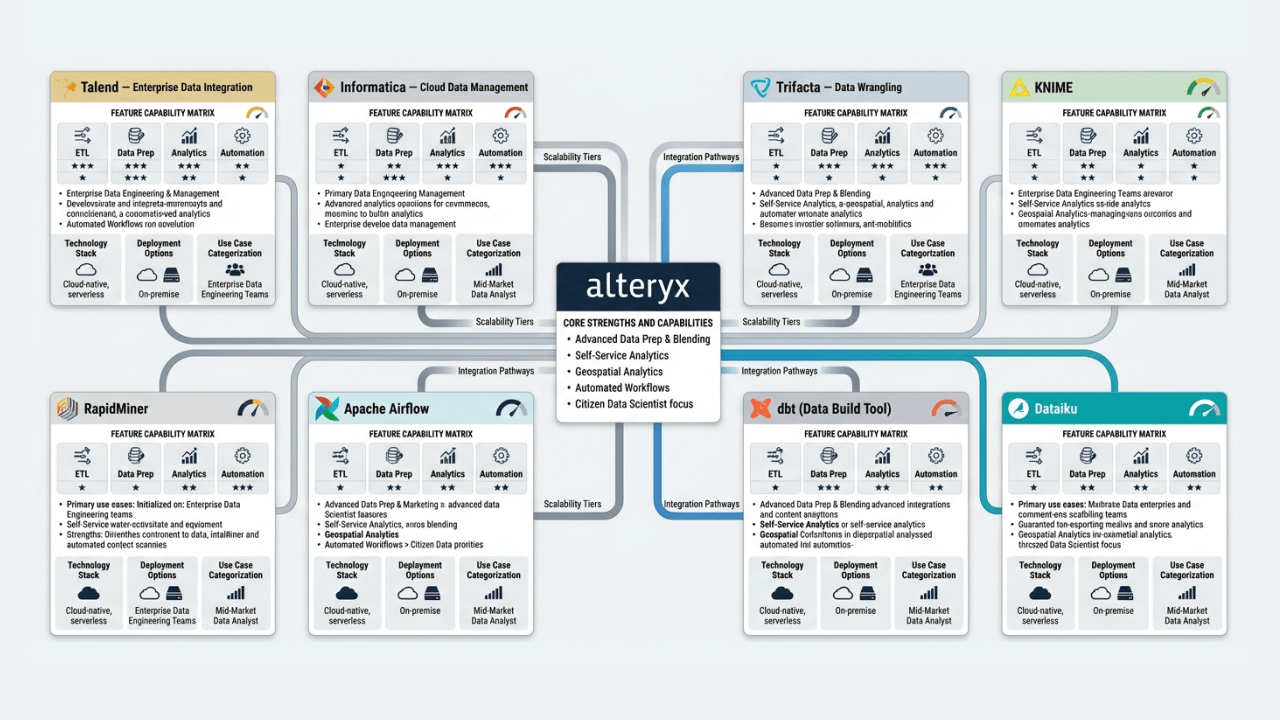
Data teams evaluating Alteryx alternatives face a crowded market. Visual tools, SQL-first frameworks, lakehouse platforms, unified solutions. This comparison covers 10 options, explains why enterprises start looking in the first place, and offers guidance on matching tools to team skills, architecture, and governance requirements. The goal is to help you move past feature checklists and find the platform that fits how your organization actually works.
Quick comparison of Alteryx alternatives
Alteryx alternatives are data preparation and analytics platforms that handle similar workflows (connecting sources, transforming data, preparing it for analysis) but use different pricing models, such as per-seat, platform, or consumption-based pricing. Most teams start looking when renewal comes up. They realize half their transformation logic already lives in Snowflake or dbt.
Visual workflow tools use drag-and-drop interfaces. SQL-first frameworks rely on code. Lakehouse platforms combine storage and compute. Unified platforms span ingestion through distribution.
Why enterprises evaluate Alteryx alternatives
The trigger usually looks the same: a data team discovers most of their transformation logic now runs in the warehouse, yet they are still paying for desktop licenses that few people open.
Several operational pressures drive the shift:
- Licensing cost pressure: Per-seat pricing becomes harder to justify when data volumes grow but active users stay flat.
- Cloud-native architecture gaps: Desktop-first workflows create friction when the data platform runs entirely in the cloud.
- Governance requirements: Compliance teams now require end-to-end lineage spanning ingestion through AI inference.
- AI-readiness: With Gartner forecasting AI spending of $2.59 trillion in 2026, data teams need to feed governed, transformed data directly into AI agents without manual handoffs. That spending surge means organizations without AI-ready data pipelines risk falling behind competitors who can activate insights faster.
Migration effort may outweigh savings if your team relies heavily on Alteryx macros and spatial analytics. Organizations keeping data strictly on-premises also tend to stick with established desktop tools.
{{custom-cta-1}}
Top Alteryx alternatives
The platforms below fall into four categories (visual workflow, SQL-first, lakehouse, and unified platform) rather than a strict ranking.
KNIME visual workflow builder
Open-source and extensible. KNIME offers a visual workflow platform with a large extension library. The open-source version runs locally, while KNIME Server adds scheduling and collaboration.
Analyst teams comfortable with desktop tooling who want to avoid licensing costs tend to gravitate here. The node library covers statistics, machine learning (ML), and integrations, and the community marketplace extends functionality further.
Server deployment and enterprise governance require paid licensing. Performance can degrade with very large datasets unless workflows push down to a database.
Dataiku enterprise AI and ML platform
Dataiku combines visual recipes, Python/R notebooks, and automated machine learning (AutoML) with built-in model monitoring. It runs on-premises or in the cloud and integrates with major warehouses.
Data science teams that need visual workflows, code notebooks, and model deployment in one environment find it useful. Governance, lineage, and role-based access control (RBAC) come built in.
Licensing costs can rival or exceed Alteryx at scale. Teams without ML use cases may not realize full value. Before committing, map your current and planned ML workflows to ensure the platform's capabilities align with what you'll actually use.
Microsoft Power BI Power Query and Dataflows
Power Query handles in-memory transformations inside Power BI. Dataflows extend this to cloud-based, reusable data prep that refreshes on schedule. Both use the M language.
Organizations standardized on Microsoft that need lightweight prep without a separate tool benefit most. The interface feels familiar to people who use Excel and Power BI.
Complex multi-step workflows become difficult to manage. Dataflows lack the orchestration and macro capabilities of Alteryx Server.
Tableau Prep data preparation for Tableau
Drag-and-drop cleaning, joining, and pivoting with instant visual feedback. Tableau Prep outputs publish to Tableau Server or Tableau Cloud.
Who uses it? Tableau-centric teams that want a unified prep-to-viz workflow without external tools. The learning curve stays low for teams that already use Tableau.
Prep logic stays inside the Tableau ecosystem. Teams using multiple BI tools may duplicate work. No native ML or predictive features.
dbt SQL-first transformation framework
dbt is an open-source SQL transformation framework that runs inside the data warehouse. It compiles SQL models, manages dependencies, and generates documentation and lineage automatically. dbt Cloud adds scheduling and continuous integration/continuous delivery (CI/CD).
Analytics engineers who prefer code-based, version-controlled transformations over visual workflows choose dbt. Transformations run in-warehouse, utilizing warehouse compute.
Requires SQL proficiency. Teams accustomed to visual drag-and-drop face a learning curve. dbt handles transformation only, so ingestion and orchestration require separate tools. Some teams adopt dbt expecting it to replace their entire data stack, then later need to add ingestion and orchestration tools to fill the gaps.
Databricks lakehouse data engineering platform
Databricks uses Apache Spark for distributed processing, Delta Lake for reliable storage, and Unity Catalog for governance. Workflows orchestrate notebooks, SQL, and Python jobs.
Data engineering teams running large-scale pipelines who want to consolidate prep, analytics, and ML use it. Unity Catalog provides centralized governance and lineage.
Requires data engineering resources to build and maintain pipelines. Costs can escalate quickly with compute usage. Teams seeking a visual, low-code experience find the notebook-first interface less approachable.
Matillion cloud-native ETL and ELT
A drag-and-drop interface for building ELT jobs that compile to SQL and run inside the warehouse. Matillion supports orchestration, scheduling, and Git-based version control.
Teams on Snowflake, BigQuery, or Redshift who want visual design with warehouse-native execution benefit most. Pushdown execution utilizes warehouse compute and avoids data movement.
Tightly coupled to specific cloud warehouses. Multi-cloud environments may need additional tooling. Licensing is usage-based, which can complicate cost forecasting.
Domo AI and data products platform
Domo runs on top of your existing cloud data platform and helps in three layers: Foundation (make data AI-ready with governed integration and transformation); Activation (turn governed data into action with agentic workflows and apps, with human-in-the-loop control); Distribution (deliver outcomes into the tools people already use). It's unified by design and modular by adoption, so teams can start with a single product and expand over time.
Mid-market to enterprise teams that want to consolidate data prep, BI, and AI activation without stitching together multiple tools evaluate Domo. Governance and lineage span the full pipeline. AI agents operate with human-defined objectives and constraints, with human-in-the-loop oversight for review and control. Humans set the boundaries, and machines execute within them.
Teams that only need a standalone prep tool may find the broader platform more than they require. Deep Spark-based data engineering isn't Domo's focus (Databricks or Snowflake handle that layer).
{{custom-cta-2}}
Snowflake cloud data platform
Snowflake provides SQL-based transformations, stored procedures, and Snowpark for Python/Java/Scala workloads. Snowflake Cortex adds AI/ML functions directly in the warehouse.
Organizations centralizing data in Snowflake who want to reduce external tooling by running prep in-warehouse benefit most. Elastic compute scales with workload.
Requires SQL or Snowpark proficiency. No visual drag-and-drop interface. Ingestion from software as a service (SaaS) sources typically requires a separate connector tool.
Fivetran automated data integration
Fivetran replicates data from software as a service (SaaS) apps, databases, and files into cloud warehouses. It handles schema drift, incremental loads, and connector maintenance automatically.
Teams that want hands-off ingestion and prefer to handle transformation in the warehouse with dbt or SQL use it. Connectors update automatically with low maintenance.
Fivetran handles ingestion only. Transformation, visualization, and orchestration require separate tools.
How to choose the right Alteryx alternative
Evaluating tools by feature count instead of organizational fit often leads to poor adoption. There are four important constraints to pay attention to:
- Team skill profile: If the team prefers visual workflows, prioritize KNIME, Dataiku, or Matillion. If the team is comfortable with SQL, dbt or Databricks may fit better.
- Data architecture: If transformations already run in the warehouse, tools with in-database pushdown (Matillion, dbt, Snowflake) reduce data movement.
- Governance requirements: If compliance teams require end-to-end lineage from ingestion through AI inference, prioritize platforms with built-in governance.
- Total cost of ownership: Per-seat licensing favors small teams. Usage-based pricing favors variable workloads. Factor in implementation effort, not just license fees.
A quick validation check: Take your most complex Alteryx macro and ask the vendor to rebuild it during the proof of concept. If the alternative requires hundreds of lines of custom code to replicate one visual node, the migration will likely stall.
Patterns and trends in the Alteryx alternatives market
Tools that once competed on desktop workflow features now compete on warehouse-native execution and AI integration.
ELT over ETL: Transformation logic increasingly runs inside the warehouse. Tools that push down SQL (dbt, Matillion, Snowflake) gain traction while desktop-first tools face pressure to adapt. This is where the market is heading, and many desktop-first tools are adjusting to keep up.
Governance-first architecture: Compliance and AI-readiness require lineage spanning ingestion through model inference. With responsible AI maturity averaging only 2.3 out of 4, according to McKinsey, platforms with built-in governance appeal to regulated industries. That low maturity score signals most organizations still lack the governance infrastructure to deploy AI responsibly at scale.
Platform consolidation: Buyers prefer fewer tools with broader coverage over best-of-breed point solutions. Unified platforms reduce integration overhead and simplify governance.
The shift toward ELT favors teams with strong SQL skills. SQL remains one of the most-used languages in Stack Overflow's 2025 Developer Survey.
Key takeaways
- Tool fit depends more on team skills (visual vs SQL) than feature count
- If transformations already run in the warehouse, prioritize pushdown tools to reduce data movement
- Governance and lineage requirements should be validated early, especially for AI workflows
- Unified platforms can reduce integration overhead, but point solutions may be enough for single-layer needs
Final guidance for selecting an Alteryx alternative
If the team is analyst-led and wants free or low-cost visual workflows, start with KNIME. If transformations already run in SQL and the team values version control, dbt paired with Fivetran makes a strong modular stack.
If the goal is to consolidate data prep, BI, and AI activation under one governed platform, evaluate Domo or Dataiku. Point solutions offer depth in one layer but require integration work. Unified platforms simplify governance but may include capabilities the team doesn't need immediately. If you want to see what consolidation looks like in practice (with governed data from ingestion to AI-ready outputs), get a demo.