AI Inference vs Training: The Two Phases That Decide Whether Your AI Ships

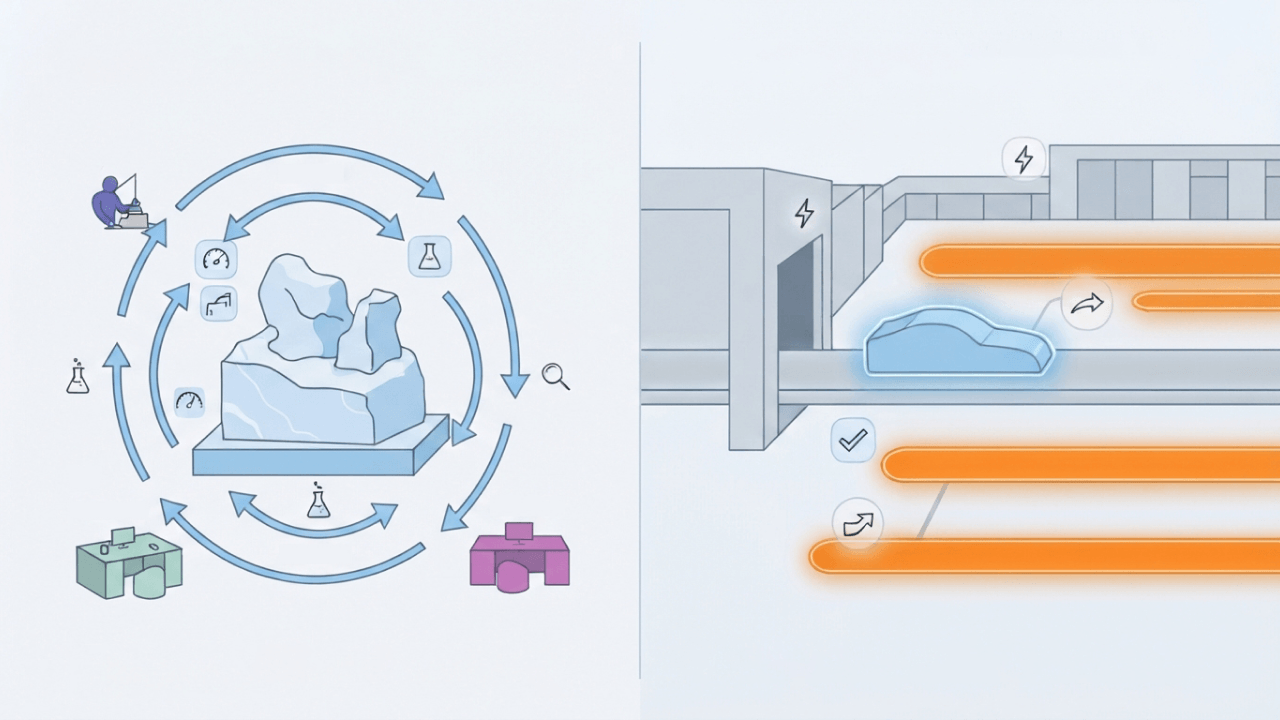
Training teaches a model to recognize patterns by updating its weights across massive datasets. Inference applies that learned knowledge to new inputs without changing anything inside the model. Simple enough on paper. But understanding where each phase fits in your AI lifecycle determines whether your initiative scales smoothly or stalls at deployment.
Key takeaways: AI inference vs training
AI training teaches a model to recognize patterns by adjusting its internal settings across massive datasets. AI inference applies that learned knowledge to make predictions on new data. Training happens before deployment in scheduled bursts. Inference runs continuously after deployment, scaling with every request your application receives.
- Core distinction: Training builds the model by updating parameters millions of times; inference uses the finished model to generate outputs without changing anything inside it.
- Cost structure: Training creates large, periodic expenses you can plan for; inference drives ongoing costs that scale directly with how many people use your application.
- Hardware needs: Training demands clusters of powerful graphics processing units (GPUs) working together; inference can run on smaller hardware, sometimes even mobile devices.
- Team ownership: Data scientists typically own training workflows; machine learning (ML) engineers and platform teams own inference infrastructure.
- Governed orchestration: Domo helps organizations prepare data for both phases and distribute AI outcomes into existing workflows without fragmenting governance.
TL;DR: Training teaches. Inference applies. The phase you underfund is the phase that breaks your AI initiative.
AI inference vs training at a glance
This table captures the operational differences that shape your budget, infrastructure, and staffing decisions.
What is AI inference and what is AI training?
AI training is the process of teaching a model to recognize patterns. You feed it labeled data, it makes predictions, calculates how wrong those predictions were, and adjusts its internal weights to do better next time. Millions of repetitions. The model performs well on data it has never seen before. That's the goal.
Inference happens after training finishes. The model's weights are frozen. You send it new data, it runs a forward pass through its learned patterns, and it returns a prediction. No learning happens during inference. The model just applies what it already knows.
Here's the boundary that matters for infrastructure decisions: during training, gradients flow backward through the network and parameters change. During inference, gradients are disabled and parameters stay fixed. Much lighter hardware requirements because the model isn't updating itself.
Teams sometimes accidentally run inference with training settings still active. This shows up more often than teams expect. Functions like dropout or batch normalization behave differently during training versus inference. Leaving them in training mode produces inconsistent outputs and wastes compute. Always set your model to evaluation mode before serving predictions. A single configuration flag can mean the difference between reliable production performance and debugging phantom accuracy drops for weeks.
How AI model training works
The training loop follows a specific sequence that repeats across your entire dataset, often hundreds of times.
- Data preparation: Collect and clean your data, then split it into training and validation sets.
- Forward pass: Feed a batch of examples through the model to generate predictions.
- Loss calculation: Compare those predictions to the actual labels using a loss function.
- Backward pass: Compute gradients that indicate how to adjust each weight.
- Parameter update: Apply those gradients using an optimizer to reduce future errors.
- Repeat: Continue across epochs until validation performance stops improving.
Compute-intensive. Every batch requires both forward and backward passes. A single training run might process billions of examples. These runs are scheduled rather than continuous (nightly, weekly, or triggered when model performance degrades).
One thing that catches teams off guard: training on data that doesn't match production leads to models that ace validation but fail when deployed. Your training data needs to reflect actual inputs. Edge cases. Seasonal variations. The messy formatting that production data inevitably contains.
How machine learning inference works
Simpler than training. But operating under strict time constraints.
- Input preprocessing: Transform raw input into the exact format the model expects.
- Forward pass: Run the preprocessed input through the frozen model.
- Output postprocessing: Convert the model output into something usable (a class label, confidence score, or generated text).
- Response delivery: Return results to the requesting application.
Each request is lighter than a training step because there's no backward pass. But inference must handle continuous traffic. Latency and throughput become your primary concerns.
Batch inference processes many inputs together for efficiency. Real-time inference processes single inputs immediately for responsiveness. Batch inference suits overnight scoring jobs like credit risk assessment. Real-time inference suits interactive applications like chatbots and fraud detection where people are waiting. Choosing the wrong mode for your use case (say, batch inference for a fraud detection system) can render an otherwise excellent model useless in production.
{{custom-cta-1}}
Key differences between AI inference and training
Purpose and lifecycle stage
Training happens before deployment. Inference happens after. But the relationship isn't strictly linear. Production feedback often triggers retraining.
Data scientists typically own training because it requires experimentation with architectures, hyperparameters, and data augmentation strategies. ML engineers and platform teams typically own inference because it requires production reliability, monitoring, and scaling.
Fine-tuning blurs this boundary. It's technically training, but on a smaller dataset to adapt an existing model to a specific domain.
Frequency and cadence
Training runs episodically. You train a model initially, then retrain periodically or when performance drifts below an acceptable threshold.
Inference runs continuously. A recommendation engine might handle a high volume of inference requests while the model behind it retrains periodically. Completely different operational concerns. Training teams worry about data freshness and compute scheduling. Inference teams worry about uptime, latency service-level agreements (SLAs), and autoscaling.
Compute and hardware requirements
Training requires high-throughput compute: multiple GPUs or TPUs working in parallel, large memory for gradient storage, and high-bandwidth interconnects for distributed training.
Inference can run on much smaller hardware. Teams often use CPUs, edge devices, or quantized models on mobile phones because each request only needs a forward pass.
Training hardware is expensive but used intermittently. Inference hardware is cheaper per unit but runs continuously and scales with traffic. For organizations with strict latency requirements and high request rates, inference infrastructure often becomes the larger cost center.
Latency and throughput
Training optimizes for throughput (samples processed per second) because the goal is completing training runs in reasonable time. Nobody is waiting for a single training example to finish.
Inference optimizes for latency because people are waiting. Throughput still matters for cost efficiency, but latency SLAs constrain how aggressively you can batch requests. Larger batch sizes improve throughput and reduce cost per request. They also increase latency because each request waits for the batch to fill.
Compute, cost, and hardware for AI training vs inference
Cost overruns in AI projects rarely come from model complexity. They come from misallocating compute between training and inference.
Training costs are large but predictable. You know when training runs happen. Inference costs are smaller per request but scale unpredictably with traffic. Organizations that budget only for training often discover that inference becomes the dominant cost once the model is in production, with Gartner forecasting 55 percent of AI-optimized cloud spend going to inference in 2026. That forecast signals a fundamental shift in where AI budgets need to focus. If you're planning infrastructure today, inference capacity deserves at least as much attention as training compute.
Training cost drivers include:
- GPU-hours: Training a large model can consume thousands of GPU-hours across multiple machines, with the median cost of training frontier models around $26 million and a maximum up to $192 million, according to Stanford's AI Index Report. That figure represents the upper bound for cutting-edge models. Even mid-sized enterprise training runs can reach six or seven figures when iteration cycles multiply.
- Data movement: Transferring large datasets to training infrastructure adds cost and latency.
- Iteration cycles: Hyperparameter tuning and experimentation multiply the number of training runs.
Inference cost drivers include:
- Request volume: Every user interaction triggers an inference compute cycle.
- Latency requirements: Tighter SLAs require more powerful hardware or lower utilization rates.
- Model size: Larger models require more memory and compute per request.
For training, use spot instances for fault-tolerant jobs. Implement checkpointing to resume interrupted runs. Reduce dataset size through intelligent sampling when full data isn't necessary.
For inference, quantization reduces model precision from 32-bit floating point (FP32) to 8-bit integer (INT8), cutting memory and compute significantly with minimal accuracy loss. Batching groups requests to improve GPU utilization. Model distillation trains a smaller model to mimic a larger one. Caching stores frequent predictions to avoid redundant inference.
One caution: don't optimize inference speed if model accuracy is the bottleneck. Faster inference delivers wrong answers faster.
{{custom-cta-2}}
AI inference and training use cases in the enterprise
Real-time inference use cases require latency-critical, continuous traffic:
- Fraud detection: Score transactions quickly enough to block them before authorization.
- Personalization: Return recommendations before people lose attention.
- Conversational AI: Respond quickly enough to feel natural.
Batch inference use cases require throughput-critical, scheduled runs:
- Credit risk scoring: Process loan applications overnight for next-day decisions.
- Churn prediction: Score the entire customer base weekly to prioritize retention outreach.
- Demand forecasting: Generate predictions for inventory planning on a daily or weekly cadence.
Training-intensive use cases occur when model quality is the primary constraint:
- Domain-specific models: Healthcare, legal, or financial models require training on specialized datasets.
- Custom entity recognition: Extracting company-specific terms requires frequent fine-tuning.
- Anomaly detection: Models must retrain as normal baseline patterns evolve.
Most enterprise AI initiatives involve all three patterns. Which one is currently limiting your business outcomes?
How Domo operationalizes AI inference and training workloads
AI initiatives usually stall between phases. That gap often shows up between building a model and changing how work gets done. Data isn't ready for training. Trained models don't reach the people who need predictions. Inference results sit in dashboards nobody checks.
The gap isn't model quality. The gap is orchestration.
Domo is the agentic platform for the intelligent enterprise, unified by design and modular by adoption. It addresses the three questions enterprise AI buyers ask: Is our data ready for AI? How does AI interact with our data? How do outcomes reach the people who change workflows?
Foundation (making data AI-ready): A large library of pre-built connectors brings data from cloud apps, databases, and on-prem systems into a governed layer. Drag-and-drop transformation tools clean and model data without requiring dedicated data engineering resources.
Activation (turning AI into action): AI agents and apps operate on governed context, reading the same trusted data definitions across the organization. Domo's AI Service layer lets teams use their preferred inference models (OpenAI, Google, Anthropic, or custom) without rebuilding data pipelines for each provider. Human-in-the-loop controls ensure AI agents operate with bounded autonomy.
Distribution (delivering outcomes into workflows): Predictions reach people through mobile apps, embedded analytics, AI assistants, and automated workflows. Role-based access carries from data ingestion through AI agents to final delivery.
Domo runs on top of your existing cloud data platform and preferred inference provider. It doesn't replace Snowflake, BigQuery, or Databricks. Domo is how more people use the governed foundation those platforms provide.
If you're ready to stop losing time (and budget) in the handoff between training and inference, see how Domo orchestrates governed data and pushes AI outcomes into workflows, get a demo.