Partecipa all'AI + Data Tour per una formazione pratica, storie di clienti reali e incontri con gli esperti di prodotto Domo vicino a te.
Registrati ora

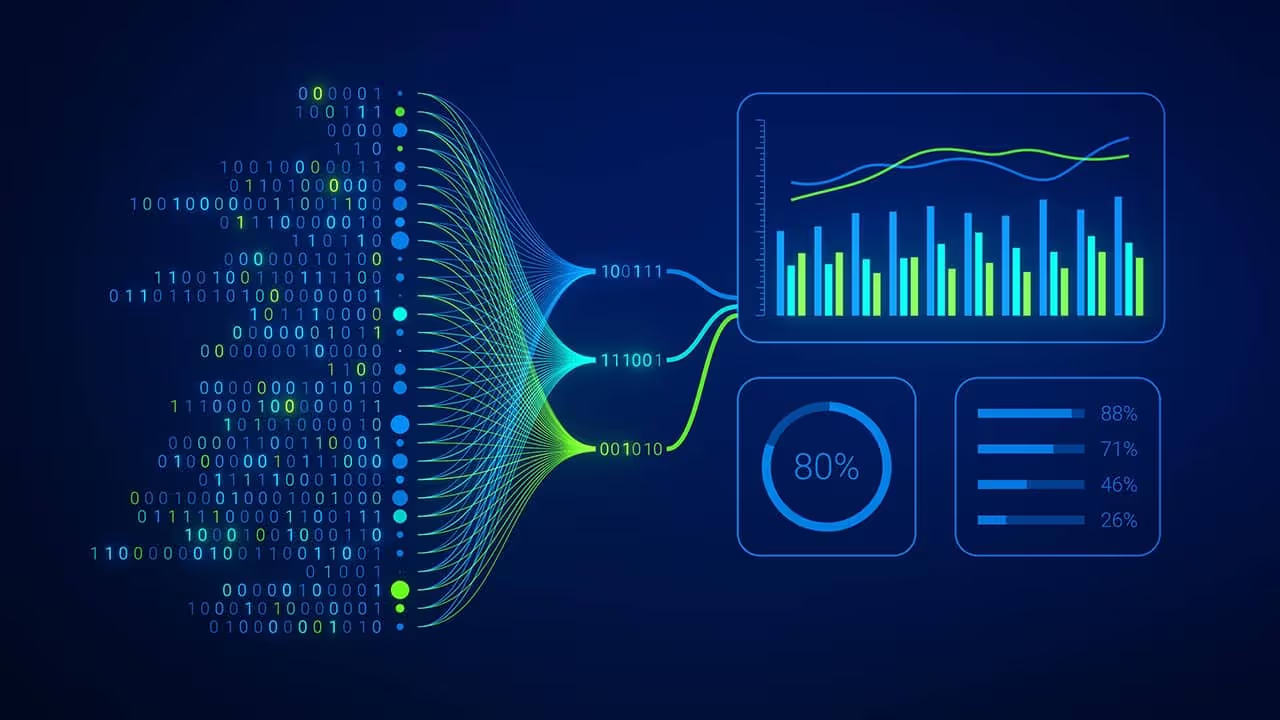
Building a data pipeline that scales with your business requires understanding design patterns like batch, streaming, extraction, transformation, and loading (ETL), and extract, load, transform (ELT), along with the governance and correctness guarantees that keep data trustworthy. This guide walks through the essential components of pipeline architecture, common challenges like schema drift and latency issues, and the steps to design pipelines that power both analytics and AI agents. You'll also learn how to implement data contracts, testing strategies, and security controls from the start rather than retrofitting them later.
Here are the main points to keep in mind:
Think of water infrastructure. Pipelines transport water to cities where it can be filtered and used. Data pipelines do the same for information, moving it from various sources to a destination where it can be analyzed and acted upon.
A data pipeline is a structured set of processes designed to automate the movement and transformation of data. The goal? Making data collection easier, more efficient, and more consistent across different systems. A well-organized data pipeline empowers an enterprise to process large volumes of data, enabling insights and analytics that drive operational and strategic initiatives. Automated data workflows eliminate manual handling, reduce errors, and improve scalability in handling diverse data formats from multiple sources. When designed with governance in mind, pipelines also create the foundation for AI-ready data that can power machine learning models and intelligent automation.
To fully understand what a data pipeline is, you will also need to understand how it differs from data integration. Both involve handling and consolidating data, but they serve distinct roles.
A data pipeline refers to the end-to-end system that automates data flow from source to destination with transformation, validation, and processing. Data integration focuses on combining data from different sources into a unified format. It often uses extraction, transformation, and loading (ETL) tools to merge structured and unstructured data for consistent organization.
Data integration is a crucial part of a data pipeline, but a pipeline also encompasses additional functions such as automation, orchestration, and real-time processing.
Before building a data pipeline, you need to understand why solid design matters in the first place. The way a data pipeline is designed can drastically affect its efficiency, playing a crucial role in the quality of your data, the speed with which you can act on insights, and how well your pipeline can scale as demands grow.
Good pipeline design has an outsized impact on data quality and accessibility. By automating the extraction, transformation, and loading of data from multiple sources, pipelines help eliminate inconsistencies, errors, and redundancies. They enforce standardization and validation, ensuring that only clean, reliable data is available for analysis.
Data pipelines also improve accessibility by transferring data to centralized repositories such as data warehouses or data lakes. Teams across an organization can access the information they need without delays or manual intervention.
Competitive organizations treat data pipelines as must-haves. They play a fundamental role in accelerating decisions and enabling action. Companies rely on real-time and historical data to make strategic choices. Without automated pipelines, decision-makers struggle with outdated or incomplete information, leading to inefficiencies and missed opportunities.
By continuously processing and delivering up-to-date data, pipelines enable analytics platforms, AI agents, and operational workflows to function with high accuracy. Businesses can identify trends, forecast outcomes, and respond proactively to market changes.
As businesses grow and handle increasing volumes of data, manual or ad hoc data processing methods become impractical. Data pipelines provide a structured, automated approach that can scale with demand, ensuring that large data sets can be processed efficiently without bottlenecks.
They also optimize performance by distributing workloads, automating workflows, and integrating with cloud-based architectures, which enhances flexibility and reliability. This scalability is particularly crucial for companies dealing with real-time analytics, machine learning applications, and large-scale customer interactions where data needs to be continuously processed and analyzed.
A well-structured data pipeline consists of several essential components that work together to move data from source to destination. Understanding how these pieces connect helps you design pipelines that are both reliable and maintainable.
Data sources are places where data is generated: databases, application programming interfaces (APIs), cloud storage, third-party services, or Internet of Things (IoT) devices. Your data can be structured, unstructured, or semi-structured.
Data ingestion happens when raw data is collected from sources and then fed into the data pipeline. Data can be ingested in batches or be streamed in real time. The ingestion method you choose depends on how quickly downstream systems need access to fresh data. Selecting an ingestion method based solely on technical capability rather than actual business requirements leads to trouble (streaming everything sounds appealing but introduces unnecessary complexity and cost when batch processing would suffice).
This step involves cleaning, filtering, aggregating, and formatting the data to ensure consistency and usability. It often includes ETL or extract, load, transform (ELT) processes. Transformation and processing make sure the data is clean, accurate, and in a usable business format.
Orchestration and workflow management components ensure that tasks run in the correct sequence or in parallel, managing dependencies and scheduling execution. Modern orchestration tools like Apache Airflow, Prefect, and Dagster help manage complex workflows and handle resource allocation so a sudden wave of data does not overwhelm your network.
A data pipeline has to have a storage layer where processed data is stored, such as in warehouses, lakes, or databases, making it accessible for analysis. Where and how you store the data will depend on what you want to use the data for and how easily you need to retrieve it.
To keep data accurate and make sure it's still moving, monitoring components track the pipeline's performance, detecting failures or inconsistencies and triggering alerts or corrective actions when needed.Observability tools provide visibility into data lineage, processing times, and error rates.
There's no single right way to design a data pipeline. Your pipeline can reflect the unique setup of your organization, what you plan on doing with the data, and more. Here are the most common data pipeline design patterns to help you choose the right approach.
Batch processing is one of the most traditional data pipeline designs. Data is collected over a period and processed in large chunks at scheduled intervals. Ideal for scenarios where real-time data isn't critical: generating financial reports, processing payroll, consolidating nightly sales data.
While batch processing may introduce some latency, it is highly efficient for handling large volumes of structured data with well-defined processing windows.
Real-time processing continuously ingests and processes data as it is generated, enabling immediate insights and actions. Essential for fraud detection, stock market analysis, and IoT monitoring, where even milliseconds of delay can be costly.
Streaming pipelines rely on technologies like Apache Kafka for message queuing, Apache Flink for stateful stream processing, and Spark Streaming for micro-batch processing. These tools ensure low-latency data movement and analysis, though they introduce additional complexity in terms of exactly-once processing guarantees and state management.
The ETL pipeline design follows a structured process where data is first extracted from multiple sources, then transformed into a standardized format, and loaded into a data warehouse or other storage systems. ETL is widely used in business intelligence and reporting, ensuring that raw data is cleaned and optimized before analysis.
ELT flips the traditional ETL sequence by first loading raw data into a storage system (such as a data lake) and then applying transformations as needed. This design takes advantage of modern cloud computing and scalable storage solutions, allowing organizations to store massive data sets without upfront transformations. ELT is particularly beneficial for big data analytics and machine learning because it provides flexibility in how and when data is processed. Teams sometimes adopt ELT assuming they can "figure out transformations later." This often leads to ungoverned data lakes where raw data accumulates without clear ownership or transformation logic.
The following table compares these approaches along with streaming:
| Dimension | ETL | ELT | Streaming |
|---|---|---|---|
| Processing location | Before loading | After loading | In-flight |
| Latency | High (batch) | Medium (batch) | Low (real-time) |
| Storage requirements | Lower (transformed only) | Higher (raw + transformed) | Variable |
| Best for | Structured reporting | Big data analytics, ML | Real-time monitoring, fraud detection |
| Complexity | Moderate | Moderate | Higher |
Lambda architecture addresses the challenge of needing both real-time and historical analysis by running parallel batch and streaming layers. The batch layer processes complete data sets for accuracy, while the speed layer handles real-time data for low latency. A serving layer then merges results from both. This approach works well when you need the accuracy of batch processing alongside real-time responsiveness, but it comes with the overhead of maintaining two separate processing codebases.
Kappa architecture simplifies this by using only a streaming layer for all processing. Instead of maintaining separate batch and streaming systems, Kappa treats everything as a stream and replays historical data when needed. Operational complexity drops. But your streaming infrastructure must handle both real-time and historical reprocessing workloads.
Event-driven architecture structures pipelines around events (state changes or actions) rather than scheduled batch jobs. When something happens in a source system, it triggers downstream processing automatically. This pattern enables loose coupling between systems and scales well because each component only activates when relevant events occur.
Microservices architecture introduces a modular approach to data pipelines, breaking down processes into independent, loosely coupled services that communicate with each other via APIs or message queues. Teams can build, deploy, and manage individual components separately.
Combining event-driven and microservices patterns creates pipelines that are both responsive and maintainable.
Production pipelines fail in predictable ways. Records arrive twice. Events show up out of order. A source system replays an entire day of data after a recovery. Without explicit correctness guarantees built into your design, these scenarios corrupt downstream analytics and erode trust in your data.
An idempotent operation produces the same result whether it runs once or multiple times. This property is essential for pipelines that may retry failed jobs or reprocess data after incidents. The most common approach uses natural keys combined with upsert logic: instead of blindly inserting records, the pipeline checks whether a record with that key already exists and updates it if so.
For streaming pipelines, idempotency often requires maintaining state about what has already been processed. This might mean storing processed event IDs in a fast lookup store or using transactional writes that atomically update both the data and the processing checkpoint. Assuming your message broker guarantees exactly-once delivery when it only guarantees at-least-once will silently break idempotency and introduce duplicate records.
Duplicates enter pipelines through multiple paths: source systems that send the same event twice, retry logic that reprocesses messages, or backfill jobs that overlap with production data. Effective deduplication requires defining what makes a record unique (the deduplication key) and deciding where in the pipeline to enforce uniqueness.
Early deduplication at ingestion reduces downstream processing costs but requires fast lookups against potentially large sets of seen keys. Late deduplication at the storage layer is simpler to implement but means duplicate records flow through transformation logic, potentially inflating intermediate metrics.
Events don't always arrive in the order they occurred. A mobile app might batch events and send them hours later. Network delays can reorder messages.
Watermarking is the standard approach in streaming systems: the pipeline maintains a threshold (the watermark) representing the oldest event time it expects to still receive. Events arriving after the watermark has advanced past their timestamp are considered late. You can choose to drop late events, route them to a separate late-data stream for manual review, or trigger recomputation of affected time windows.
For batch pipelines, late data handling often means designing incremental loads that can update previously computed results rather than assuming each batch is complete and final.
Even well-designed pipelines encounter problems. Understanding common challenges helps you build defenses into your architecture from the start rather than scrambling to fix issues in production.
The tension between data freshness and processing cost is constant. Batch pipelines are efficient but introduce latency. Streaming pipelines provide fresh data but consume more resources and introduce complexity around exactly-once processing.
The solution isn't always to stream everything. Instead, classify your data by freshness requirements. Financial fraud detection needs millisecond latency. Monthly reporting can tolerate overnight batch processing. Understanding the tradeoffs between batch and stream processing helps you design your pipeline architecture around these requirements rather than applying a single approach everywhere.
Source systems change. A field gets renamed, a new column appears, or a data type shifts from integer to string. Without proper handling, these changes break downstream transformations and corrupt analytical outputs.
Proactive approaches include implementing schema validation at ingestion, using schema registries to track and version changes, and designing transformations that can gracefully handle new or modified fields. Data contracts between producing and consuming teams also help by establishing explicit expectations about what data will look like.
As organizations add more data sources and use cases, pipeline sprawl becomes a real problem. Different teams build overlapping pipelines with inconsistent logic. Nobody knows which pipeline is authoritative for a given metric. Debugging failures requires tracing through multiple disconnected systems.
Addressing this requires both technical and organizational solutions: centralized orchestration for visibility, data lineage tracking to understand dependencies, clear ownership models for pipelines and data products, and governance policies that balance agility with consistency.
Governance retrofitted after deployment is expensive and incomplete. Pipelines that handle sensitive data need security and compliance controls embedded from the start, not bolted on as an afterthought.
The first step is knowing what you're moving. Implement data classification at ingestion to identify personally identifiable information (PII), protected health information (PHI), financial data, and other sensitive categories. This classification drives downstream decisions about encryption, access control, and retention.
For PII specifically, consider tokenization or pseudonymization early in the pipeline. Replacing sensitive values with tokens before data reaches transformation layers limits exposure and simplifies compliance. Store the mapping between tokens and original values in a separate, tightly controlled system with its own access policies.
Apply least-privilege access at every layer. Ingestion credentials should only have read access to source systems. Transformation jobs should only access the specific tables they need. Analysts should see aggregated or masked data unless they have explicit approval for row-level access.
Encryption requirements span both transit and rest. Data moving between pipeline components should use Transport Layer Security (TLS). Data stored in warehouses, lakes, and intermediate staging areas should use encryption with keys managed through your cloud provider's key management service or a dedicated secrets manager.
Regulatory frameworks like the General Data Protection Regulation (GDPR), the Health Insurance Portability and Accountability Act (HIPAA), and System and Organization Controls 2 (SOC 2) require demonstrable evidence of who accessed what data and when. Build audit logging into your pipeline from day one, capturing access events, transformation executions, and data lineage.
Retention policies need to balance compliance requirements (some regulations mandate minimum retention periods) with privacy requirements (others mandate deletion after a maximum period).
Designing an enterprise data pipeline requires a strategic approach to efficiently collect, process, and store extensive amounts of data. Here's a step-by-step guide to designing a data pipeline that's scalable and reliable.
Before investing any time or money into a data pipeline, you need to know exactly what your goals are. These goals will guide your decisions through the rest of the pipeline-building process.
Ask yourself what metrics you want to focus on. What workflows will this data enable? What decisions will it inform? What kinds of resources can you dedicate to data processing? Defining success in terms of outcomes (faster decisions, automated workflows, reduced manual reporting) rather than outputs (dashboards created, data volume processed) keeps the project focused on business value.
Equally important is defining your SLOs upfront. These should include latency targets (how fresh does the data need to be?), reliability targets (what percentage of pipeline runs must succeed?), and quality targets (what error rates are acceptable?). A pipeline serving fraud detection might require p99 latency under 500 milliseconds and 99.9 percent availability. A monthly reporting pipeline might tolerate 24-hour latency and 99 percent availability.
When designing and implementing an enterprise data architecture pipeline, organizations need to remember that the architecture must support the core business processes. Not the other way around. Standardize and document core business processes across the entire enterprise.
The better you document business processes, the more easily you'll be able to build a pipeline that includes all necessary data and doesn't take resources away from essential business functions. This documentation should include data sources, ownership, update frequency, and quality expectations.
Your data ingestion method will depend on how quickly you need the data and how much of your resources you want to spend on data processing. Enterprises typically ingest data from multiple sources, such as transactional databases, APIs, logs, IoT devices, and third-party platforms. Depending on the use case, data can be ingested in batch mode or in real-time using streaming technologies.
The right transformation process will depend on what types of data you have, how quickly you need it processed, and what kind of data modeling you want to use.
Organizations often use a combination of data warehouses, data lakes, and hybrid storage architectures to accommodate diverse data needs. Data warehouses like Amazon Redshift, Google BigQuery, and Snowflake are optimized for structured, query-driven analytics, making them ideal for business intelligence and reporting. Data lakes such as AWS S3, Azure Data Lake, and Google Cloud Storage offer flexibility by storing raw, semi-structured, and unstructured data at scale, supporting big data and machine learning workloads.
Implement monitoring to track pipeline performance and identify issues. You should also implement policies for data access, security, and privacy. Data governance is crucial for regulatory compliance as well as for your company's own safety and data quality.
Data contracts formalize the agreement between data producers and consumers about what data will look like. A contract typically specifies the schema (field names, types, and constraints), update frequency, quality guarantees, and ownership. When a source system needs to make a breaking change, the contract process ensures downstream consumers are notified and have time to adapt.
Schema registries provide the technical infrastructure for contract enforcement. They store versioned schemas, validate that new data conforms to the expected structure, and can block incompatible changes from reaching production. For streaming pipelines using Kafka, tools like Confluent Schema Registry or AWS Glue Schema Registry integrate directly with your message brokers.
Pipelines need the same testing rigor as application code. Unit tests validate individual transformation functions with known inputs and expected outputs. Integration tests verify that components work together correctly, including connections to source systems and storage layers.
Data quality tests run against actual pipeline outputs, checking for null rates, referential integrity, value distributions, and reconciliation against source totals. These tests should run automatically as part of your deployment process, blocking releases that introduce quality regressions.
Consider maintaining a synthetic data set that mirrors production characteristics without containing sensitive information.
Implementing best practices when designing your data pipeline can be the difference between smooth, reliable data and a pipeline that gives you issues for months to come.
A critical best practice is including thorough documentation and version control strategies, which provide clarity on the pipeline's structure, transformations, and dependencies. Proper documentation details data sources, ingestion methods, transformation logic, and storage destinations, ensuring that teams can understand and troubleshoot the pipeline efficiently.
Version control allows teams to track changes, roll back updates, and maintain consistency across different environments. Modular design takes this further by organizing pipelines into discrete, reusable components. When a transformation logic needs updating, you change it in one place rather than hunting through monolithic scripts.
Implementing monitoring and alerting mechanisms is crucial for pipeline performance, ensuring that data flows without unexpected failures or bottlenecks. Real-time monitoring tools help track key performance indicators like data latency, throughput, and error rates.
Establishing automated alerting mechanisms allows teams to detect anomalies like missing data, pipeline failures, or performance degradation and take corrective action before issues escalate. Beyond basic monitoring, define and enforce service level agreements (SLAs) for data freshness and quality. If a pipeline promises hourly updates, build alerting that triggers when that commitment is at risk, not after it is already broken.
Continuous improvement and optimization techniques help maintain pipeline efficiency as data volumes and business needs evolve. Optimizing query performance, parallelizing workloads, and using distributed computing frameworks can significantly enhance processing speed.
Plan for schema evolution from the start. Implement data quality checks and schema validation so erroneous or incomplete data can be flagged early in the pipeline. Use schema registries to track changes over time and design transformations that handle additive changes gracefully. Adopting an iterative approach to pipeline development enables organizations to deploy updates while maintaining system stability. Regularly reviewing and refining the pipeline based on performance insights is what ensures long-term scalability and efficiency. You'll notice the teams that do this consistently are the ones who avoid the 2 am emergency calls.
The gap between having data and getting value from it often comes down to pipeline design. Organizations that treat pipelines as plumbing miss the opportunity to build a foundation that supports not just reporting, but AI agents, automated workflows, and intelligent decision-making.
Domo approaches this through three layers: Foundation (making data AI-ready), Activation (turning AI into action through agents and apps on governed data with human-in-the-loop controls), and Distribution (delivering outcomes into the workflows people already use). Your pipeline investment compounds over time rather than creating isolated data silos.
Whether you're connecting to Snowflake, Databricks, or your existing cloud data platform, Domo helps you build AI-ready data pipelines that serve both human analysts and intelligent systems.
Data, logic, and governance are defined once and reused everywhere, so expansion strengthens your data infrastructure rather than complicating it.
To learn more about how Domo can help you design pipelines that power both analytics and AI, contact us today.